






April 1 marks the foundation day of the Reserve Bank of India, established in 1935. On this occasion, let’s look at its history, functioning, and the new initiatives launched. In “Beyond the Hunk,” also learn about the measures taken by the RBI to control the falling rupee amidst the West Asia war.
Take a look at the essential concepts, terms, quotes, or phenomena every day and brush up your knowledge. Here’s your hunk of knowledge on the RBI for today.
Hunk of Knowledge: Reserve Bank of India (RBI)
Subject: History and Economy
Why in the news?
On April 1, 1935, the Reserve Bank of India (RBI) was established in accordance with the provisions of the Reserve Bank of India Act, 1934. It is responsible for monetary stability, currency management, inflation targeting, regulating the banking system, and setting interest rates.
Key takeaways:
1. It was set up on the basis of the recommendations of the Royal Commission on Indian Currency (Hilton Young Commission) which was set up in 1926. It recommended establishing a central bank to be called the ‘Reserve Bank of India’.
2. RBI is tasked with regulating the issue of banknotes, maintaining reserves with a view to securing monetary stability and to operate the credit and currency system of the country to its advantage.
3. The first Governor of the RBI was the Australian Sir Osborne Arkell Smith, one of the two managing governors of the Imperial Bank of India. Sir C D Deshmukh was the first Indian to become Governor.
4. The Central Office of the Reserve Bank was initially established in Kolkata but was permanently moved to Mumbai in 1937. The Central Office is where the Governor sits and where policies are formulated.
5. RBI was nationalised from 1st January, 1949 on the basis of the Reserve Bank of India (Transfer to Public Ownership) Act, 1948. All shares in the capital of the Bank were deemed transferred to the Central Government on payment of a suitable compensation.
6. The affairs of the RBI is governed by the Central Board of Directors consisting of the Governor and not more than four Deputy Governors. Non-official directors nominated by the government consist of ten Directors from various fields and two government officials along with four Directors – one each from four local boards.
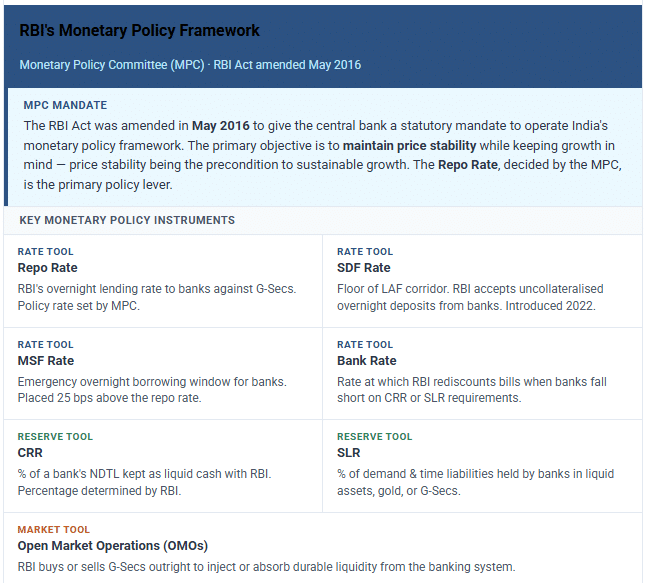
7. RBI has four local boards: Western Area, Eastern Area, Northern Area and Southern Area. It consists of five members each who are appointed by the Central government for a term of four years. However, since 2022 these local boards are not functioning due to lack of quorum. As per the RBI, a Standing Committee of the Central Board is functioning in the areas where Local Boards are unable to function for want of quorum.
8. RBI performs several functions from maintaining price stability, issuing currency to banker to the government and banks. One of the significant functions which becomes important in the current times is the management of the forex reserve. It manages the Foreign Exchange Management Act, 1999 to facilitate external trade and payment and promote orderly development and maintenance of the foreign exchange market in India.
New initiatives of the RBI
New rules for digital payments starting April 1, 2026: To make digital transitions safer and reduce fraud, RBI has introduced new rules for digital payments. It is making two-factor authentication mandatory, which means OTP alone will no longer be enough. It will need an extra step to complete transactions, like entering a PIN or password, or using your fingerprint or face scan. At the same time, RBI is also making banks more accountable. If a fraud happens because of weak security, banks may have to compensate customers.
e-cheques: In an effort to modernise India’s payment ecosystem, the Reserve Bank of India has proposed the introduction of electronic cheques (e-cheques). This initiative aims to merge the trusted, well-established features of traditional paper cheques with the efficiency, speed and security of digital payment systems, while also catering to evolving business and consumer needs. An e-cheque is a digital version of a paper cheque created and sent online instead of on paper. The payer fills in the details, signs it securely using a digital method, and sends it to the payee or bank. The bank verifies and processes it like a normal cheque, but it is faster, more secure, paperless and easy to track.
MuleHunter.AI: It is an AI-powered tool developed by the RBI to reduce digital fraud by helping banks deal with the increasing problem of “mule” bank accounts. A mule account is a bank account that is used by criminals for illegal activities, including the laundering of illicit funds. A mule account is typically bought over by the criminals from their original users, individuals who are often from lower income groups, or have low levels of technical literacy.
BEYOND THE HUNK: Amid the West Asia war crisis, the task at hand for the RBI
1. The falling value of the rupee, rise in oil prices, and fears over inflation in the wake of the West Asia conflict led the RBI to take action. It instructed banks to limit their net open exposure to the currency in the foreign exchange market to $100 million by the end of each day. Authorized dealers must comply with this rule by April 10.
2. The RBI’s goal in taking this step is to stabilise the falling rupee and protect the country’s foreign exchange reserves, which have fallen since the West Asian conflict started a month ago. The RBI’s measure is aimed at halting the rupee’s decline by limiting how much foreign currency exposure banks can maintain onshore. Previously, banks could hold net open positions up to 25 per cent of their total capital, a much higher allowance than under this the new cap.
3. Further, as the pressure on the currency built up, the RBI has used the dollar in its forex kitty to stabilise the rupee. As a result, the country’s forex reserves have fallen by over $30 billion, to $698.34 billion, since the conflict began. India’s forex reserves have four components: foreign currency (FX) assets, gold, Special Drawing Rights (SDRs), and the Reserve Tranche Position with the International Monetary Fund (IMF).
4. However, the recent rupee breached 95-per-dollar, left many speculating about the effectiveness of these measures. Michael Patra, former deputy governor of the Indian central bank, in an interview with Siddharth Upasani, said that the RBI should lean on the US’s Foreign and International Monetary Authorities (FIMA) Repo Facility to ensure US dollars are “flushed continuously in and out of the market.”
5. Under the Foreign and International Monetary Authorities (FIMA) Repo Facility, central banks such as the RBI can place their holdings of US Treasuries with the Fed for one or seven days and get dollars in return. At the end of this period, the dollars must be returned to the Fed, along with some interest, and foreign central banks get back the securities. The use of the facility would have a “stabilising influence” on the market, economise the RBI’s use of its forex reserves, and give it time to rebuild them, the former central banker said.
6. Impact of falling rupee: When the Indian currency depreciates, the first and most immediate casualty is the import bill. Crude oil, electronic components, fertilisers and industrial machinery — all priced in dollars — suddenly become more expensive. The burden then steadily shifts to businesses and households, pushing up inflation and eroding purchasing power.
7. A $1 rise in crude oil increases India’s annual import bill by roughly $1.5–2 billion, depending on total import volumes. This directly widens the current account deficit (CAD). In simple words, CAD means India imports more goods and services than it exports. This, in turn, implies that the demand for the foreign currency (say the US dollar) is more than the demand for the Indian rupee.
Post Read Question
Consider the following statements about the RBI:
1. The RBI was set up on the recommendation of the Hilton Young Commission.
2. The MuleHunter.AI tool developed by IIT Delhi is being made compulsory for the commercial banks.
3. The Foreign and International Monetary Authorities (FIMA) Repo Facility is provided by the RBI.
Which of the statements mentioned above is/are correct?
(a) 1 only
(b) 2 and 3 only
(c) 2 only
(d) 1, 2, and 3
| Answer key |
| (a) |
Don’t miss | UPSC Current Affairs Pointers of the past week (23–29 March 2026) | UPSC Lifebloods | Hunk of Knowledge




About Author





More Stories
UPSC Current Affairs Pointers of the past week | 27 April – 03 May 2026
Hunk of Knowledge | PM Modi’s Pushes Ethanol at Jewar airport: Why this biofuel is important for UPSC exam
Not words, but power : India inducts nuclear-powered ballistic missile submarine INS Aridhaman