





Are you getting ready for the UPSC CSE Prelims 2026? Ensure you stay informed about crucial current affairs updates. Discover details about the Constitution (131st Amendment) Bill, anticipatory bail, the MLFF tolling system, the condition of bats in India, Operation Upstream, and much more
Polity
Official language of Meghalaya
- The Meghalaya cabinet on 16th April, 2026 announced the indigenous Khasi and Garo languages as the official languages of the state, in addition to English.
- The move comes amid a long-standing demand for the inclusion of Khasi and Garo – the languages of the state’s two largest tribes – in the Eight Schedule of the Constitution. Currently, all official business in the state is carried out in English.
Anticipatory bail
- The Supreme Court has refused to extend the transit anticipatory bail earlier granted to Congress leader Pawan Khera by the Telangana High Court.
- The FIR against Pawan Khera was filed by Riniki Bhuyan Sharma, following a press conference where Khera levelled serious allegations of financial and legal misconduct.
- Black’s Law Dictionary (4th edition) describes ‘bail’ as procuring “the release of a person from legal custody, by undertaking that he shall appear at the time and place designated and submit himself to the jurisdiction and judgement of the court.”
- As opposed to ordinary bail, which is granted to a person who is under arrest, in anticipatory bail, a person is directed to be released on bail even before arrest made.
- The Bharatiya Nagarik Suraksha Sanhita, 2023 (BNSS) contains provisions for anticipatory bail in Section 482 (earlier Section 438 of the Code of Criminal Procedure). The provision empowers only the Sessions Court and High Court to grant anticipatory bail.
- Sub-section (1) of the provision reads: “When any person has reason to believe that he may be arrested on an accusation of having committed a non-bailable offence, he may apply to the High Court or the Court of Session for a direction under this section; and that Court may, if it thinks fit, direct that in the event of such arrest, he shall be released on bail.”
- In the 1980 Gurbaksh Singh Sibbia vs State of Punjab case, a five-judge Supreme Court bench led by then Chief Justice Y V Chandrachud ruled that S. 438 (1) is to be interpreted in the light of Article 21 of the Constitution (protection of life and personal liberty).
Constitution (One Hundred and Thirty-First Amendment) Bill, 2026
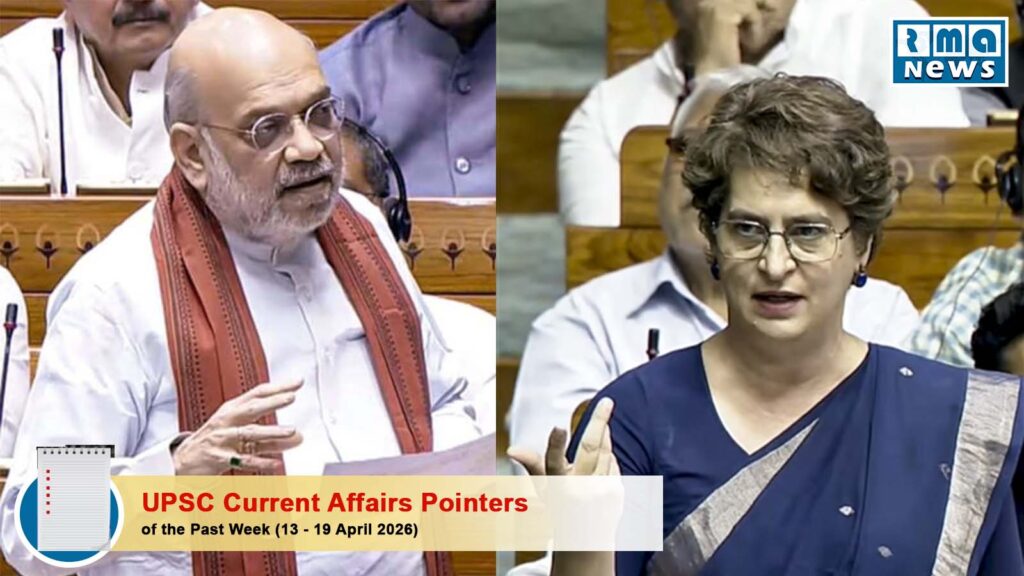
- This week, the Lok Sabha has taken up three bills, namely the Constitution (131st Amendment) Bill, 2026, the Delimitation Bill, 2026, and the Union Territories Laws (Amendment) Bill, 2026, for consideration and passing.
- The 131st Amendment Bill failed to get 2/3rd majority in the Lok Sabha. Following the defeat, Union Minister for Parliamentary Affairs Kiren Rijiju told the Lok Sabha Speaker not to take up the two other Bills since these were linked to the Constitutional (131st Amendment) Bill, 2026.
- The Bill intended to increase the number of seats in the Lok Sabha from 543 to 850. Out of 850 seats, 815 members to be elected from the States and 35 members from the Union territories. The objective of the bill was to implement one-third reservation for women in the Lok Sabha as well as the assemblies of States and Union Territories.
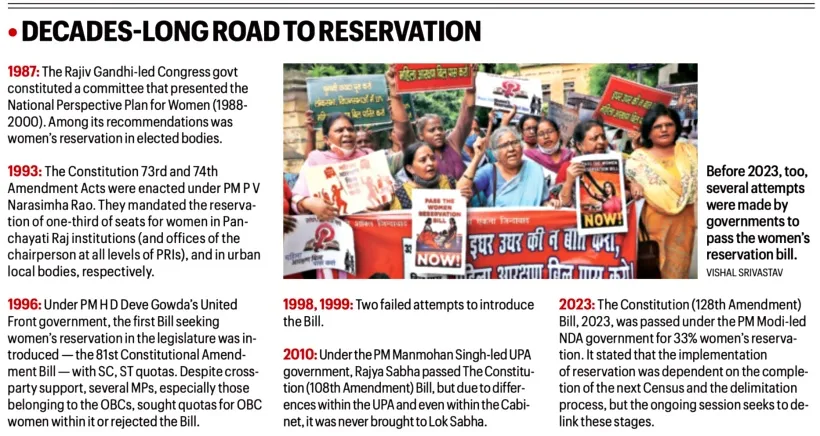
- The Bill aimed to amend the Nari Shakti Vandan Adhiniyam, 2023, to expedite women’s reservation, a Delimitation Bill to set up a Delimitation Commission based on the latest available population figures, and a Bill to extend women’s reservation to Union Territories with Legislative Assemblies.
- The Nari Shakti Vandan Adhiniyam, which was passed in 2023, provided that a one-third reservation for women will come into effect after the delimitation exercise based on the first census after the commencement of the Act.
Deputy Chairman of Rajya Sabha
- Rajya Sabha Deputy Chairman Harivansh is set to be elected unopposed for a third term on 17th April, 2026, with the Opposition deciding to boycott the elections.
- The Deputy Chairman is a constitutional position created under Article 89 of the Constitution, which specifies that the Rajya Sabha shall choose one of its MPs to be the Deputy Chairman as often as the position becomes vacant.
- The Deputy Chair is the one position that is elected solely by members of Rajya Sabha. It is a critical position not just because s/he steps in when there is a vacancy in the office of Chairperson/Vice President but also because s/he plays a critical role in ensuring the smooth running of the House.
International Cooperation
9th Indian Ocean Conference
- India Foundation, in association with the Government of Mauritius, organised the 9th Indian Ocean Conference—IOC 2026—in Mauritius from April 10 to 12, 2026
- The theme of the conference was “Collective Stewardship for Indian Ocean Governance.”
- The conference brings together leaders, policymakers, and experts from across the Indian Ocean Region to deliberate on shared responsibilities, cooperative frameworks, and the future of regional governance.
Section 301 investigations
- Responding to two Section 301 investigations launched by the US in March 2026, on “structural excess capacity” and “forced labour”, the Indian government told Washington on 16th April, 2026, that its legal framework aligns with the forced labour standards of the International Labour Organisation (ILO).
- The US launched two Section 301 investigations against several countries, including India. While one cites structural excess capacity and overproduction in certain manufacturing sectors, the other cites failure to prohibit imports of goods produced using “forced” labour.
- Section 301 authorizes the U.S. Trade Representative (USTR) to investigate whether foreign governments are engaging in “unfair” acts, policies, or practices that burden or restrict U.S. commerce.
- The Section 301 investigation assumes significance for India as US Treasury Secretary Scott Bessent said that Trump’s tariffs could be restored by July to the level they were at before the Supreme Court struck them down.
Environment
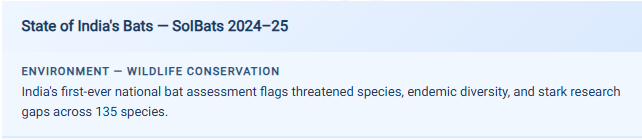
State of India’s Bats (SoIbats), 2024-25
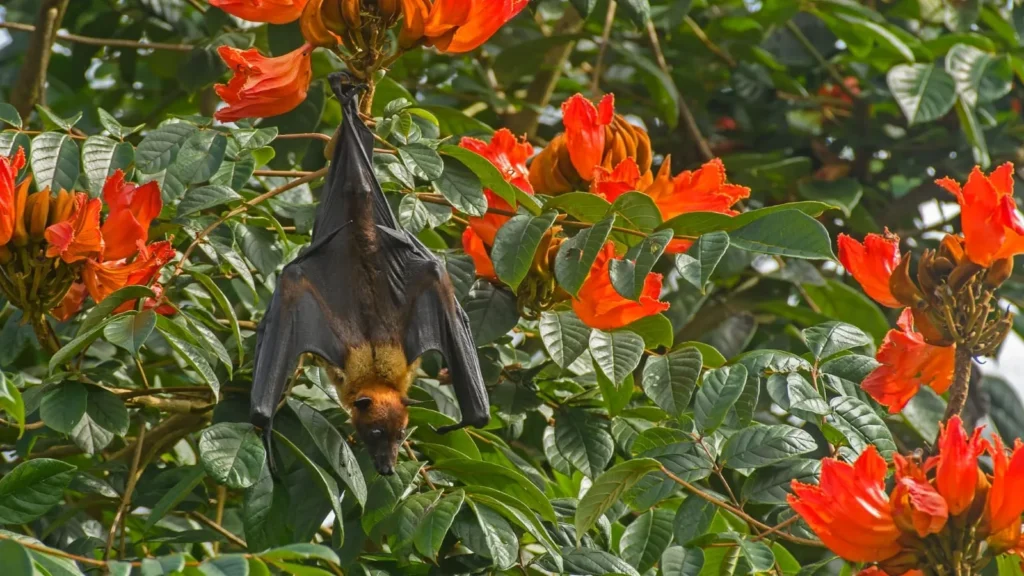
- The first-ever national assessment, State of India’s Bats (SoIbats), 2024-25, pointed out that the bat species in India, around 135, are facing neglect due to a lack of research and are also under threat from urbanisation, deforestation, land-use changes, and climate impacts.
- SoIbats was conducted in collaboration with the Nature Conservation Foundation (NCF) and Bat Conservation International (BCI).
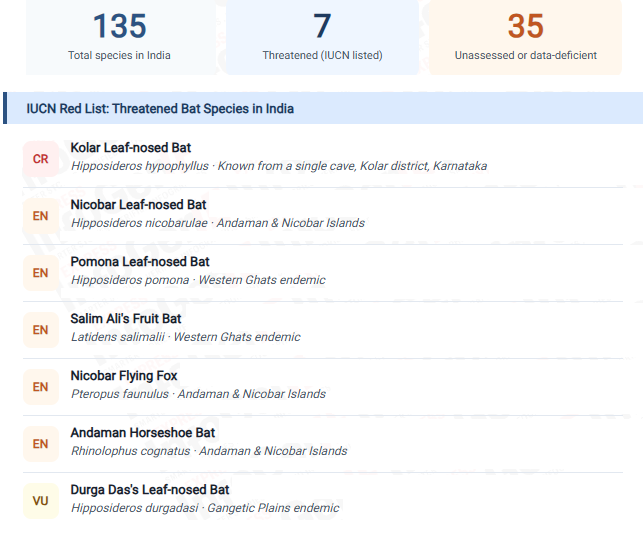
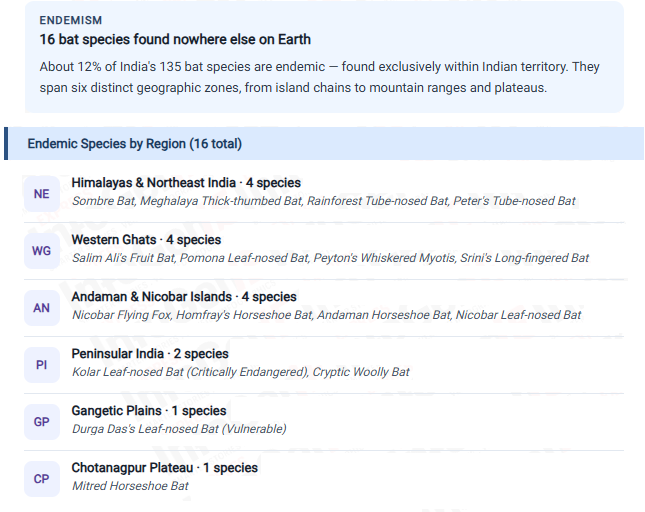
- Out of 135 bat species, 16 are endemic (about 12 percent of the total bat) or only found in India and seven of them are listed under the threatened category by the International Union for Conservation of Nature.
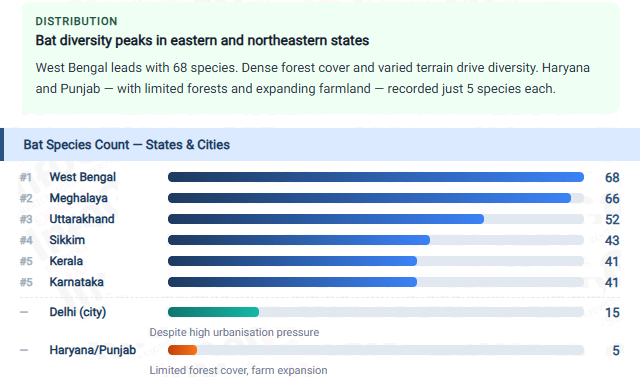
- The report documented significant inter-variability in the distribution of bat species. West Bengal leads with 68 bat species, followed by 66 in Meghalaya, 52 in Uttarakhand 41 each in Kerala and Karnataka and 43 in Sikkim, denoting diversity.
Science and Technology
Induction vs infrared cooktops
- Amidst the shortage and black market of LPG, there has been a shift toward electric alternatives, such as induction and infrared cooktops. Online retail platforms like Amazon India have reported a sharp spike in sales, with induction cooktops seeing up to an 18-fold jump compared to pre-war levels.
- A basic induction cooktop uses electricity to heat the vessel directly. It works by generating a rapidly changing electromagnetic field.
- When the metal pan is placed on the surface, it comes under the magnetic field. The electrical resistance of the metal creates an electrical friction between the two, which then converts the kinetic energy of the moving electrons directly into thermal energy or heat.
- Cookware: An induction works best with ferromagnetic cookware, which contains materials like cast iron or magnetic stainless steel that respond to magnetic fields. For this, there is a need for compatible cookware that makes it more expensive than the ones normally used on gas stoves.
- Unlike induction, infrared cooktops use a heated coil beneath a glass surface to generate radiant heat, which can then warm any type of vessel — including steel, aluminium, glass, and ceramic — without requiring magnetic compatibility.
- Process of heating: Unlike an induction cooktop, infrared cookstoves rely on radiant heating for heating the vessel. Put simply, electricity heats a coil or halogen element placed beneath a ceramic glass surface. As it heats, it begins to glow red-hot — similar to the heating wire in a toaster. This hot element then emits infrared radiation, a form of electromagnetic energy that is invisible to the human eye.
- This radiation passes through the glass surface and is absorbed by the base of the cookware. The absorbed energy causes the molecules in the vessel to vibrate, generating heat that cooks the food.
- Energy Efficiency: Induction cooktops convert 85–95% of electricity into heat by directly heating the vessel using electromagnetic fields. In contrast, infrared cooktops operate at around 70–80% efficiency, as heat is first generated in a coil, then transferred to the glass surface, and finally to the vessel.
An induction cooktop typically consumes slightly less electricity than an infrared cooktop for the same task. Induction cooktops use power electronics — usually rapid switching (pulse‑width modulation) or frequency adjustment — to control the heat. This allows them to maintain efficiency even at low heat settings like simmering.
Infrared cooktops usually reduce heat by adjusting the electricity waveform using a method called phase‑angle control. Here, the glowing coil turns on only for a short part of each cycle and then turns off, instead of staying on steadily. This method is simple and effective, but it distorts the current waveform and can reduce the power factor. For this, the grid has to supply extra current.
Multi-Lane Free Flow (MLFF) tolling system
- The National Highway Authority of India (NHAI) has issued directions to all FASTag-issuing banks to immediately validate Vehicle Registration Numbers (VRNs) or license plate numbers linked to the FASTags they have issued. It also comes in the backdrop of a push for a Multi-Lane Free Flow (MLFF) tolling system.
- The MLFF is an advanced facility that allows vehicles to pass through toll gates at high speeds, without stopping or slowing at toll plazas. Accurate VRN mapping with FASTag is critical for MLFF tolling.
- The MLFF or barrier-less tolling system does not have boom barriers. The toll is collected after high-performance Radio Frequency Identification readers and Automatic Number Plate Recognition cameras read the FASTag and VRN. In the absence of human intervention in this process, a mismatch in the VRN linked to the FASTag could see commuters pass without paying the fee.
- FASTag is an electronic toll collection system managed by the National Payments Corporation of India (NPCI) and the NHAI. FASTag sticker is usually pasted on the windscreen of a car. It was launched in 2014 as a pilot project and made mandatory at every toll plaza in the country in 2021.
- It uses Radio Frequency Identification (RFID) technology to communicate with scanners installed at toll plazas. Once the car crosses a toll plaza, the requisite toll amount is automatically deducted from a bank account or a prepaid wallet linked to the FASTag.
Sports Genomics Programme
- The ‘Sports Genomics Programme’ is launched by the Gujarat government to conduct whole genome sequencing of talented athletes in the state to identify and record genetic markers associated with endurance and power sports.
- According to GBRC Director Dr Snehal Bagatharia, “In a key study published in 2023, 128 genetic markers (DNA polymorphisms) showed a positive association with athlete status. A total of 41 markers were related to endurance, 45 to power, and 42 to strength.”
- It is being undertaken by the Gujarat Biotechnology Research Centre (GBRC), under the Department of Science and Technology of the state, in coordination with the Sports Authority of Gujarat.
- Under the programme, for which Rs 26.05 crore has been allocated for five years, the GBRC will collect at least 2,000 genetic samples per year over five years, with the 10,000 samples covering 10 sports – five endurance and power sports each.
Genome India Project
It was approved by the Union government in 2020 to create a comprehensive catalogue of genetic variations found in the Indian population. A map of genetic diversity is essential for understanding the history of our evolution, discovering the genetic basis for various diseases, and creating therapies of the future.
The human genome is essentially a biological instruction manual that we inherit from our parents. It is a tome written with just four letters, A,C,G, and T — the four bases that come together to create everyone’s unique genetic makeup.
India’s first indigenous quantum computing testing facility in Amaravati
- Andhra Pradesh Chief Minister N Chandrababu Naidu formally launched India’s first indigenous quantum computing testing facility at SRM University in Amaravati.
- The Amaravati Quantum Reference Facility (AQRA) facility at Amravati was inaugurated on World Quantum Day (14th April), and with this, India now has open sovereign quantum infrastructure.
| According to the World Quantum Day, “the World Quantum Day is celebrated on April 14, a reference to 4.14, the rounded first digits of Planck’s constant: 4.1356677×10⁻¹⁵ eV⋅s = 0.000 000 000 000 004 1356677 electron volt second, a product of energy and time that is the fundamental constant governing quantum physics.” |
- The initiative features two distinct platforms: the 1Q testbed at Medha Towers and the 1S testbed at SRM University, Amaravati. It was launched under the Andhra Pradesh government’s flagship quantum technology hub which is under India’s National Quantum Mission.
- National Quantum Mission (NQM) was launched at a total cost of Rs. 6003.65 crore from 2023-24 to 2030-31, to seed, nurture, and scale up scientific and industrial R&D and create a vibrant & innovative ecosystem in Quantum Technology (QT).

Designer Rice
- Scientists at CSIR – National Institute for Interdisciplinary Science and Technology in Thiruvananthapuram, Kerala, have developed a “designer rice” that packs three times the protein of normal grains while maintaining a low glycemic index (below 55) to help manage diabetes.
- Instead of genetic modification, the scientists have used food-processing technology.
- They took broken rice, the bits usually sold at a discount—ground them into flour, and blended them with protein and micronutrients like iron, folic acid, and Vitamin B12. They then “reformed” this mixture into grains that look, feel, and taste exactly like the rice we know.
- Protein powerhouse: While normal rice has about 6–8 per cent protein, this version boasts over 20 per cent.
- Fortified defense: It bridges the gap for anaemia by embedding iron, folic acid, and Vitamin B12 directly into the grain’s structure.
Economy
Delhi Dehradun Economic Corridor
- The Delhi-Dehradun Expressway corridor was inaugurated by Prime Minister Narendra Modi on April 14, 2026
- The corridor is built at a cost of Rs 11,868 crore, the 210-km highway is expected to cut down travel time to 2.5 hours.
- Apart from connectivity to Dehradun, the highway is designed with a spur to Haridwar to facilitate connection with the Char Dham highway.
Man-Made Fibre (MMF)
- The Textiles Ministry is pushing for another round of customs duty cuts on several input items related to man-made fibre (MMF) to cushion war impact, The Indian Express has learned.
- The Indian Express had reported that the biggest impact of the war has been on the prices and availability of poly-ethylene terephthalate (PET).
- PET is used in polyester fibre that goes into the production of roughly 40% of India’s apparel production, as 60% is still cotton-based.
- Man-made fibres (MMF) are mainly of two types: synthetic and cellulosic. Synthetic fibres are produced from crude oil, and cellulosic fibres are from wood pulp. The main varieties of synthetic staple fibres are polyester, acrylic and polypropylene. Cellulosic fibre is viscose fibre, modal, etc.
Indian economy 6th largest in the World
- According to the latest World Economic Outlook (WEO) released by the International Monetary Fund (IMF), India is now the 6th largest economy in the world, slipping from the 4th position.
- According to the latest WEO, in 2026 India’s gross domestic product — the total value of all goods and services produced inside the country — will be around $4.15 trillion (up from $3.92 trillion in 2025) while the UK’s GDP will be $4.27 trillion (up from $4 trillion in 2025) and Japan’s GDP would actually fall from $4.48 trillion in 2025 to $4.38 trillion in 2026.
Persons in News

Péter Magyar
- Péter Magyar is set to become the Prime Minister of Hungary after defeating Viktor Orbán who had been in power for 16 years.
- The election witnessed a historic turnout of nearly 80%, the highest in its post-communist history of 36 years.
- Magyar now faces the unsavoury challenge of remaking the “illiberal democracy” Orbán leaves behind.
- His Tisza Party secured a comfortable two-thirds majority (138 of 199 seats based on a preliminary count), which will allow it to amend the constitution and undo several Orbán-era policies.
- Today, Hungary is the EU’s most corrupt member, according to the anti-corruption watchdog, Transparency National. It is also its poorest member regarding household welfare, according to 2025 Eurostat data.
- The European Commission has withheld an estimated €18 billion ($21 billion) in funding from Hungary since 2022 over concerns about its democratic backsliding — equivalent to roughly 10% of the country’s GDP.
Samrat Choudhary
- BJP leader Samrat Choudhary was sworn in as the Chief Minister of Bihar, marking the first time the party will lead a government in the state.
- Nitish Kumar, who is now a Rajya Sabha MP, relinquished the chief minister’s post on April 14, 2026, dissolving his Cabinet in which Choudhary was a deputy chief minister and held the crucial Home portfolio.
Anita Chaudhary
- Anita Chaudhary, a 30-year-old forest guard at Rajasthan’s Shergarh Wildlife Sanctuary, won the prestigious Machhli National Award from the World Wildlife Fund for Nature (WWF).
- The WWF’s ‘Machchli National Award’, named after the famous Ranthambhore tigress and including a cash component of Rs 50,000, was the fourth recognition of her work.

Sadhvi Satish Sail
- Sadhvi Satish Sail was crowned Miss India World 2026 at the grand finale of the 61st Femina Miss India pageant held in Bhubaneswar.
- Crowned by her predecessor Nikita Porwal, Sail is all set to represent India at the Miss World 2027 pageant.
Sports
(Just FYI: With the unpredictability of the UPSC examinations and questions like the ICC World Test Championship question 2021, you can’t be sure of anything. It is wise to know what it is and not go into too much detail.)
Operation Upstream
- The World Anti-Doping Agency (WADA) has decided to collaborate with the Central Bureau of Investigation (CBI) to take a ‘top to down’ approach to curb anti-doping activities in the nation as the Sports Ministry pushes for criminalization of suppliers of prohibited substances to athletes.
- Operation Upstream, a joint CBI-WADA action plan, will target supply chains that move prohibited performance-enhancing drugs, and punish coaches, physios of doping athletes.
- Currently, India is the country with the largest number of dope offenders in the WADA list of suspended athletes from 2024. The nation has been a regular feature in the top three list, pointing at a deep-rooted problem related to the usage of prohibited substances and performance-enhancing drugs.
- Other hurdles that India faces in curbing doping activities are the lack of personnel at the National Anti-Doping Agency and lapses in procedures at the National Dope Testing Laboratory (NDTL). One of the 29 WADA-accredited labs in the world, NDTL was suspended in 2019 due to non-conformities with international standards.
Test Your Knowledge
(Note: The best way to remember facts for UPSC and other competitive exams is to recall them through MCQs. Try to solve the following questions on your own.)
- Consider the following statements about the anticipatory bail:
1. In anticipatory bail, a person is directed to be released on bail even before an arrest is made.
2. The Sessions Court and High Court can grant anticipatory bail.
Which of the statements mentioned above is/are correct?
(a) 1 only
(b) 2 only
(c) 1 and 2
(d) None of the above - Consider the following statements:
1. Nicobar Flying Fox is listed as a Critically Endangered species on the IUCN Red List.
2. West Bengal has the highest number of bat species as per the SoIbats, 2024-25.
3. Most microbats use echolocation to navigate.
Which of the statements mentioned above is/are correct?
(a) 1 and 2 only
(b) 2 and 3 only
(c) 1 and 3 only
(d) 1,2, and 3
| Prelims Answer Key |
| 1. (c) 2. (b) |
If you missed the UPSC Current Affairs Pointers of the past few weeks : Click Below Links
UPSC Current Affairs Pointers of the past week | 06– 12 April 2026 read it here
UPSC Current Affairs Pointers of the past week | 30 March – 5 April 2026 read it here
UPSC Current Affairs Pointers of the past week | 23– 29 March 2026 read it here
UPSC Current Affairs Pointers of the past week | 16– 22 March 2026 read it here
UPSC Current Affairs Pointers of the past week | 09– 15 March 2026 read it here




About Author




More Stories
UPSC Current Affairs Pointers of the past week | 18–24 May 2026
UPSC Current Affairs Pointers of the past week | 11–17 May 2026
UPSC Current Affairs Pointers of the past week | 04–10 May 2026