






India’s unincorporated sector supports millions of livelihoods and contributes to the overall growth. But what does the Annual Survey of Unincorporated Sector Enterprises 2025 reveal about the nature of growth in this sector?
— Pushpendra Singh and Archana Singh
India’s economic growth is usually framed around large firms, expanding markets, and rising enterprises. But much of this growth also rests on a sector that largely remains unchanged: the unincorporated non-agricultural sector. It absorbs labour, sustains livelihoods, and supports local demand.
But this raises an important question: does expansion in this sector signal progress or mask the persistence of informality?
The latest findings from the Ministry of Statistics and Programme Implementation’s (MoSPI) Annual Survey of Unincorporated Sector Enterprises (ASUSE) 2025 bring this into focus. Beneath the visible economy lies a vast network of unincorporated, non-agricultural enterprises like small manufacturers, service providers, and trading units.
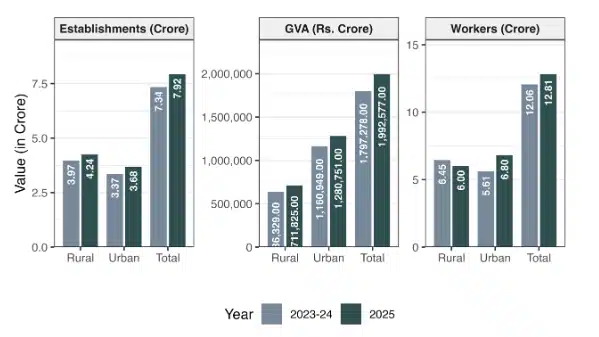
This sector supports millions of livelihoods and anchors local demand. According to ASUSE, this sector comprises 7.92 crore establishments and employs 12.81 crore workers, which makes it one of the largest sources of work in the country.
Arithmetic of expansion in scale and employment
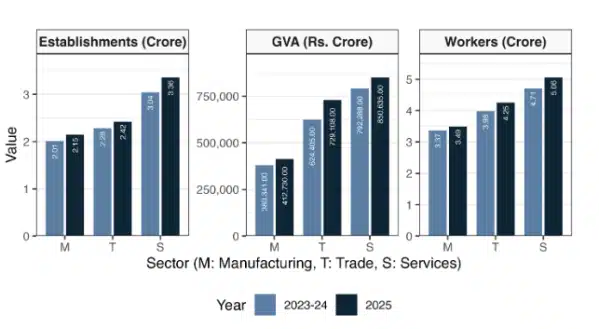
The number of informal establishments has increased from 7.34 crore in 2023-24 to 7.92 crore in 2025, reflecting a growth of nearly 8 per cent. This rise reflects the steady entry and survival of small economic units. A closer look at these numbers also reveals that the distribution of this growth across sectors largely remains unchanged: 27 per cent in manufacturing, 31 per cent in trade, and 42 per cent in ‘services’.
Figure 1 : Expansion of India’s Unincorporated Sector: Establishments, GVA, and Employment (2023-24 to 2025)
Source: Annual Survey of Unincorporated Sector Enterprises (ASUSE) 2025
Further, employment has also expanded to 12.81 crore workers, registering a growth of 6.18 per cent. This confirms the sector’s role as a primary absorber of labour. But the nature of this employment remains unchanged. Around 62 per cent of workers are owner-operators, while only 24 per cent are hired workers. This reveals the nature of growth. Although employment is growing, it is largely driven by self-employment and family labour. The sector generates work, but not stable and wage-based jobs.
Rising output and value addition
Alongside the increase in establishments and employment, the sector has also recorded a rise in output. Gross Value Added (GVA) grew by 10.9 per cent between 2023-24 and 2025. The services account for the largest share in GVA (42%) followed by trade (37%) and manufacturing (21%). This indicates increasing activity in buying and selling goods, even without significant transformation.
While manufacturing is still important, it shows relatively moderate growth. This reflects the continued dominance of small-scale production units that operate with limited capital and technology. This shift toward services and trade suggest a changing structure within the informal economy. It points to the increasing importance of demand-driven, localised services in shaping economic activities.
Figure 2: Sectoral Growth in India’s Unincorporated Economy: Establishments, GVA, and Employment (2023-24 to 2025)
Source: Annual Survey of Unincorporated Sector Enterprises (ASUSE) 2025
Productivity, wages, and earnings
One of the key indicators of economic progress is productivity. ASUSE 2025 data shows that the per worker GVA – or the difference in the value of inputs used and output produced – increased from 1.49 lakh to 1.56 lakh. Although it registers a growth of about 4.5 per cent, it is down from 5.6 per cent in 2023-24.
In addition, the scale of improvement remains modest. They do not suggest a major shift in technology, skills, or scale of operations. This pattern is consistent with the nature of the sector. Most enterprises operate with limited capital, rely on traditional methods, and serve local markets, without significant changes in factors of productivity.
The results show a rise in wages in the unincorporated non-agricultural sector, with average annual wage/emolument per hired worker increasing by 3.88 per cent – from 1,41,071 in 2023-24 to 1,46,550 in 2025. However, this increase is relatively small when compared to the growth in GVA. This suggests that the benefits of higher output are not translating into higher earnings for workers. It also reflects the limited bargaining power of labour within informal settings.
Progress of women-owned enterprises
One of the notable trends in ASUSE 2025 is the increase in women-owned proprietary establishments. Their share has risen from 26 per cent to 27 per cent. While this marks progress, the change is modest, largely due to the persistence of some structural barriers.
Access to credit remains constrained, particularly for women entrepreneurs who lack collateral assets (like land, gold) or formal financial history (like previous loans, bank transactions). Market linkages are often weak, limiting the scale and reach of their enterprises. As a result, many women-led enterprises remain small, home-based, and concentrated in low-value activities.
How West Asia war poses risks to unorganised sector
Such structural factors also make the unorganised sector susceptible to external shocks. The ongoing war in West Asia poses a measurable risk to this sector through well-established transmission channels.
India imports over 80 per cent of its crude oil, with a significant portion sourced from West Asia, specifically via the Strait of Hormuz. The war has led to a sharp increase in fuel prices. The potential rise in transport and input costs is likely to have a corresponding effect on small, unincorporated enterprises operating on thin margins.
ASUSE 2025 shows that trade and services together account for 80 per cent of GVA in in the informal sector, both of which are highly sensitive to logistics and energy costs. At the same time, remittances from West Asia support household demand in many regions. If these flows weaken, local consumption falls. For the informal sector, such shocks are not external, they are likely to be felt directly.
From counting enterprises to strengthening them
The most defining feature of the unincorporated sector is its informality. ASUSE data shows that nearly 95 per cent of establishments operate as proprietary or partnership units. This structure has both strengths and limitations.
On the one hand, it allows for flexibility, low entry barriers, and quick adaptation to changing conditions. On the other hand, it constrains access to formal finance, limits scalability, and reduces the availability of social security for workers.
The unincorporated sector remains central to India’s economy. Nearly 8 crore enterprises and 12.8 crore workers reflect scale, not strength. The output is rising, but jobs remain informal. The productivity is improving, but at the margin. The women are entering, but not advancing. This is not a story of transformation. This is a story of persistence.
The question is no longer whether the sector is growing. It is whether it is changing. Until policy shifts from counting enterprises to strengthening them, India’s largest workforce will remain trapped between survival and stagnation.
Post read questions
Growth in the unincorporated sector reflects scale but not structural transformation. Discuss in the context of recent ASUSE findings.
Examine the structural constraints of India’s unincorporated sector and their implications for employment quality and productivity.
Examine the challenges faced by women entrepreneurs in the informal sector, particularly in accessing credit and scaling their enterprises.
Discuss the vulnerability of small, informal enterprises to input cost shocks and suggest measures to enhance their resilience.
Discuss the role of government policy in transitioning informal enterprises into formal and productive units.
Pushpendra Singh is an Assistant Professor of Economics at Somaiya Vidyavihar University, Mumbai, and Archana Singh is an Assistant Professor of Gender and Economics at the International Institute for Population Sciences, Mumbai.
Don’t miss | UPSC Current Affairs Pointers of the past week (23–29 March 2026) | UPSC Lifebloods | Hunk of Knowledge




About Author





More Stories
UPSC Current Affairs Pointers of the past week | 27 April – 03 May 2026
Hunk of Knowledge | PM Modi’s Pushes Ethanol at Jewar airport: Why this biofuel is important for UPSC exam
Not words, but power : India inducts nuclear-powered ballistic missile submarine INS Aridhaman