





Are you gearing up for the UPSC CSE Prelims 2026? Ensure you stay updated on vital current affairs snippets. Discover the World Press Freedom Index, the White-Bellied Heron, GaN (Gallium Nitride) technology, the Drishti satellite, key aspects of NCRB data, the TARA system, and beyond. Additionally, tackle the MCQs and evaluate your results.
Report
(FYI: The data provided in these reports can be used to substantiate your Mains answer and create a broad understanding of the topic.)
World Press Freedom Index 2026
- World Press Freedom Index, which evaluates 180 countries, recorded its lowest average score in the index’s 25-year history.
- It is an annual report published by Reporters Without Borders.
- For the first time in the Index’s 25-year history, more than half the world’s countries now fall into the “difficult” or “very serious” categories for press freedom.
- For the first time, in over half of the world’s countries and territories (52.2%), the state of press freedom is categorised as “difficult” or “very serious.” This category was a small minority (13.7%) in 2002.
- According to the Report, “The Index’s legal indicator has seen the most severe decline this year. This score deteriorated in more than 60% of states — 110 out of 180 — between 2025 and 2026. This is notably the case in India (157th), Egypt (169th), Israel (116th) and Georgia (135th).”
- The index measures five key areas—economic, legal, security, political, and social conditions affecting journalism. Among these, the legal environment has worsened the most this year.
- At the top of the index, Norway retained the number one position for the 10th consecutive year, while Eritrea remained at the bottom for the third year in a row.
- As for India, it slipped further down the rankings. From 151st place in 2025, it now stands at 157th in 2026, with a global score of 31.96. The country remains in the “very serious” category.
| Rank | Country | Status |
| 1 | Norway | Good |
| 2 | Netherlands | Good |
| 33 | Australia | Satisfactory |
| 87 | Nepal | Problematic |
| 134 | Sri Lanka | Difficult |
| 153 | Pakistan | Very serious |
| 157 | India | Very serious |
| 175 | Afghanistan | Very serious |
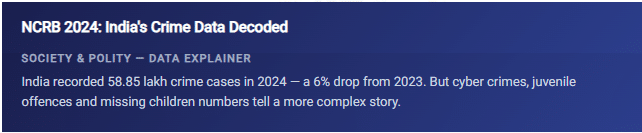
NCRB data
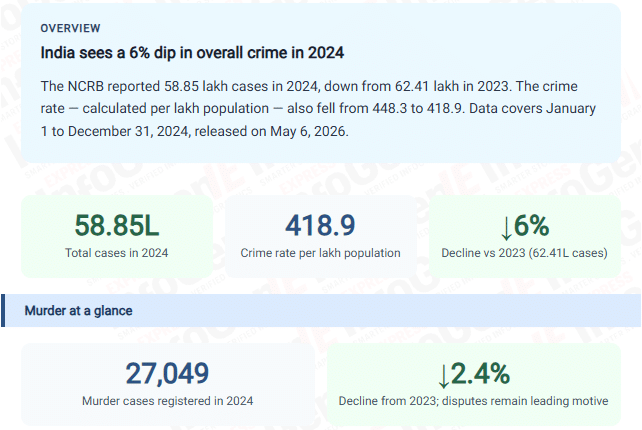
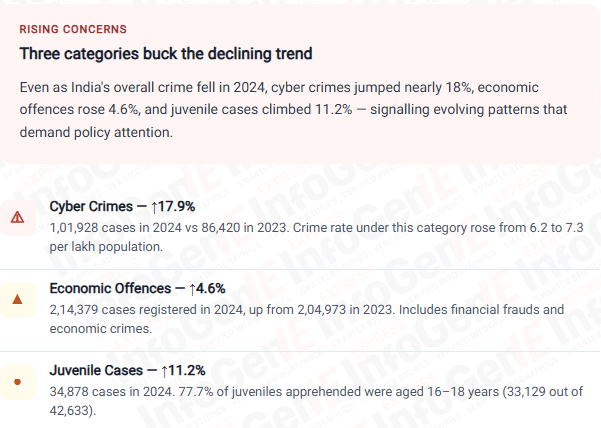
- According to the latest data released by the National Crime Records Bureau (NCRB), India witnessed an overall decline in crime cases with a 6% dip in 2024, recording 58.85 lakh cases as against 2023’s 62.41 lakh cases
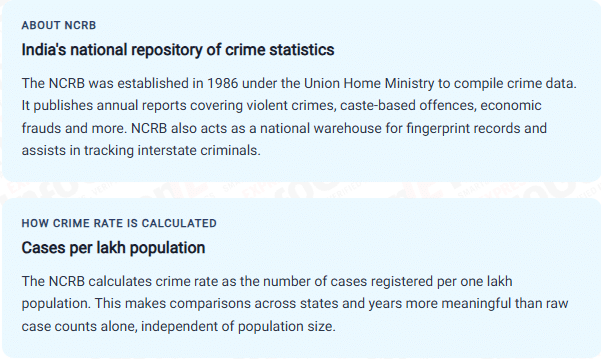
- The NCRB calculates the crime rate on the basis of the number of cases registered per lakh population. It saw a dip during the period – from 448.3 in 2023 to 418.9 in 2024.
- Cyber crimes saw an almost 18% jump in the period.
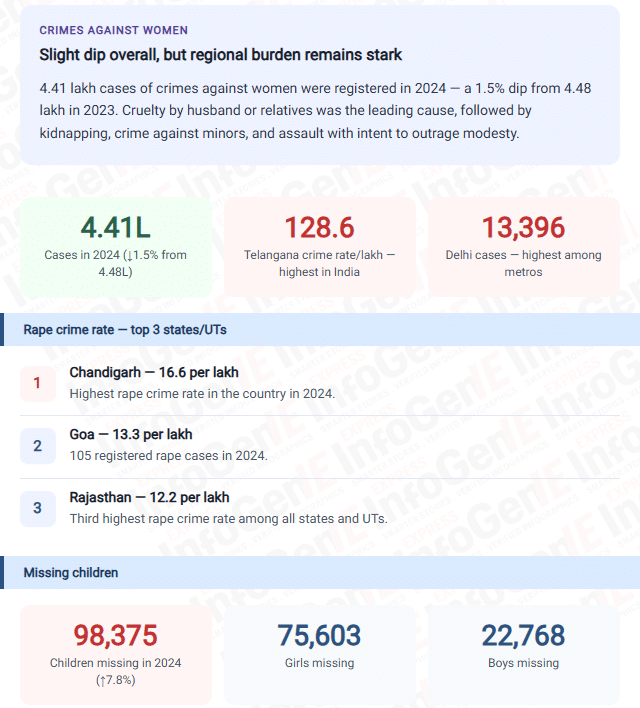
- Crime against women showed a dip of 1.5% from the previous year, with 4.41 lakh cases lodged in 2024 as compared to 4.48 lakh the previous year.
- Telangana recorded the highest crime rate against women in the country in 2024. The state reported a crime rate of 128.6 cases per one lakh population, the highest in India, followed by Odisha at 118.3.
Polity
Emergency Credit Line Guarantee Scheme 5.0
- With an aim to meet the additional credit needs of industries under distress amid the ongoing West Asia conflict, the Union Cabinet has approved a credit support scheme named ‘Emergency Credit Line Guarantee Scheme 5.0’
- It targets additional credit flow of Rs 2.55 lakh crore including Rs 5,000 crore for airlines.
- The ECLGS was launched in May 2020 as part of the Aatmanirbhar Bharat Abhiyaan to support eligible MSMEs and other eligible businesses in meeting their operational liabilities amid disruption caused by the COVID-19 pandemic.
- 100% guarantee is provided to Member Lending Institutions (MLIs) in respect of the credit facility extended by them under the scheme to eligible borrowers.
- The later versions of the scheme have covered Mudra borrowers and other stressed sectors including healthcare, hospitality, leisure, travel, tourism and civil aviation.
Supreme Court (Number of Judges) Amendment Bill, 2026
- The Union Cabinet on 5th May approved the Supreme Court (Number of Judges) Amendment Bill, 2026, to increase the strength of judges in the Supreme Court from the existing 34 to 38.
- The Bill has amended the Supreme Court (Number of Judges) Act, 1956.
- Currently, the Act provides for a maximum of 33 judges of the Supreme Court, excluding the Chief Justice of India. The amendment increases that to 37 judges, excluding the CJI.
- The last time the strength of the court was increased was in 2019, when an amendment raised it from 30 to 33, excluding the CJI. Originally, the Act had provided for a maximum of 10 judges, excluding the CJI, which was increased to 13 in 1960 and then 17 in 1977.
- The strength was further increased in 1986, 2008 and 2019.
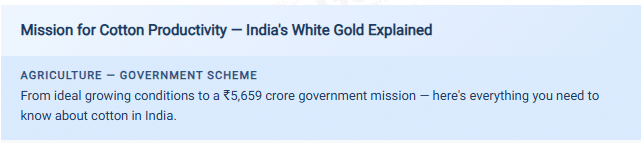
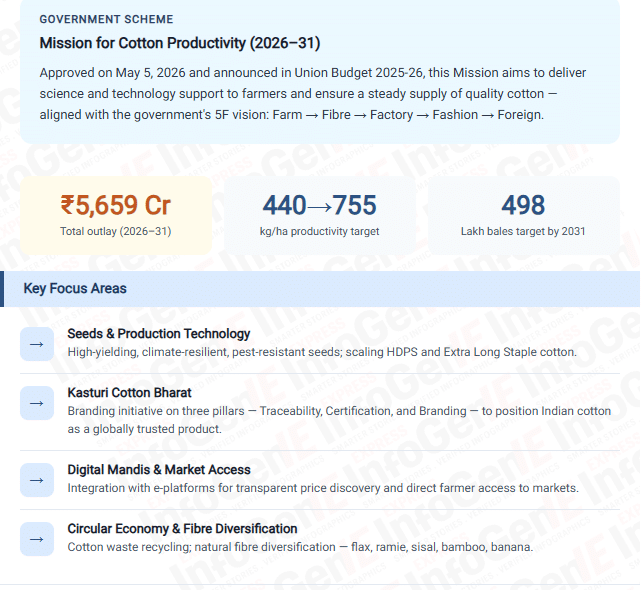
Mission for Cotton Productivity (2026–27 to 2030–31)
- The Centre on 5th May approved Rs 5,659.22 crore for the Mission for Cotton Productivity for five years (2026–27 to 2030–31). The scheme was announced in the Union Budget 2025-26.
- It is aligned with the 5F vision (Farm to Fibre to Factory to Fashion to Foreign) of the Government for the textile sector.
- It aims to provide “the best of science & technology support” to farmers and “ensure a steady supply of quality cotton” for the Indian textile industry.
About Cotton
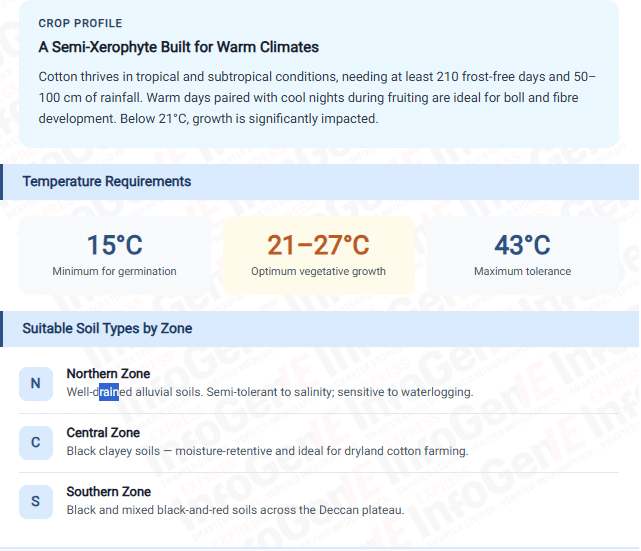
Cotton, a semi-xerophyte, is grown in tropical and subtropical conditions. It is popularly called“White Gold” and primarily a Kharif crop. The minimum temperature required for better germination under field conditions is 15 degrees Celsius. The optimum temperature for vegetative growth is between 21 and 27 degrees Celsius, and it can tolerate temperatures to the extent of 43 degrees Celsius; however, temperatures below 21 degrees Celsius impact its growth.
International Cooperation
India-Vietnam elevate ties
- India and Vietnam have decided to elevate bilateral ties to ‘Enhanced Comprehensive Strategic Partnership’ during the recent visit of President of Vietnam To Lam.
- Both countries have set a new trade goal of $25 billion by 2030 and increased defence systems procurement.
- India was one of the first countries with whom Vietnam entered into a Strategic Partnership in 2007. This was also India’s first Strategic Partnership within the ASEAN region. The two countries elevated the relations to a Comprehensive Strategic Partnership in 2016.
Economy
New SOP for FDI
- The government has issued a new Standard Operating Procedure (SOP) as per which foreign direct investment (FDI) proposals will be required to be processed within 12 weeks.
- As per the new SOP, the Department for Promotion of Industry & Internal Trade (DPIIT) is expected to disseminate the proposal to ministries concerned, Reserve Bank of India (RBI), Ministry of Home Affairs (MHA) and Ministry of External Affairs (MEA) within two days.
- Under the new SOP, investments in broadcasting, telecommunications, space, private security agencies, defence, civil aviation, and mining and mineral separation of titanium-bearing minerals and ores, its value addition, and integrated activities shall require security clearance from MHA.
Environment
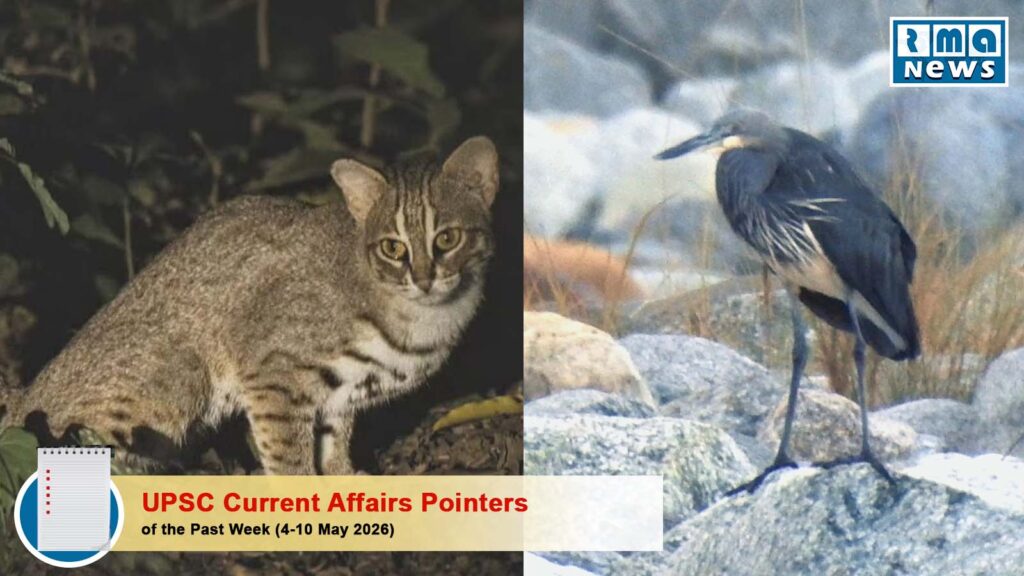
White-Bellied Heron
- A THDC India Ltd proposal seeking clearance for the Kalai-II hydroelectric project in Arunachal Pradesh does not make any mention of the habitat of the critically endangered White-Bellied Heron.
- Lohit River is a habitat for the critically endangered White-Bellied Heron, which has been accorded Scheduled-I status, the highest protection, under the Wildlife Protection Act, 1972.
- The bird is critically endangered, as per the Red List of the International Union on Conservation of Nature (IUCN). The bird’s presence has been recorded both upstream and downstream of the Kalai-II project.
- It is endemic to the fast-flowing Himalayan freshwater riverine habitats, spanning across Bhutan, India, Myanmar, China, and Bangladesh.
They are an indicator of the health of the Himalayan freshwater ecosystem. Their elusive and highly habitat specific habit in feeding, nesting, and food selection make them great environmental sensors.
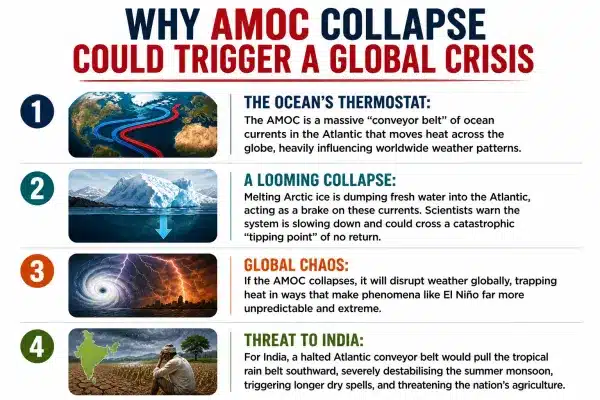
Atlantic Meridional Overturning Circulation (AMOC)
- New researchers have suggested that the Atlantic Meridional Overturning Circulation (AMOC), which regulates climate across much of the globe, may slow by up to 59% by 2100.
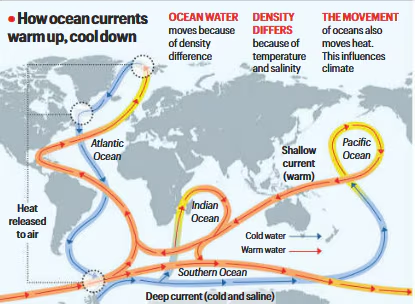
- The AMOC is a large system of ocean currents. It is the Atlantic branch of the ocean conveyor belt or thermohaline circulation (THC), and it distributes heat and nutrients throughout the world’s ocean basins.
- AMOC carries warm surface waters from the tropics towards the Northern Hemisphere, where it cools and sinks. It then returns to the tropics and then to the South Atlantic as a bottom current. From there, it is distributed to all ocean basins via the Antarctic circumpolar current.
- Gulf Stream, a part of the AMOC, is a warm current responsible for the mild climate on the Eastern coast of North America as well as Europe. Without a proper AMOC and Gulf Stream, Europe will be very cold.
- Though the AMOC is in the Atlantic, its breakdown would trigger chaos in the Pacific.
- El Niño is a periodic warming of the Pacific Ocean that disrupts global weather. Because global ocean currents and wind patterns are deeply interconnected, a sluggish AMOC traps heat in the southern hemisphere and leaves the North Pacific cooler.
- This throws off the delicate temperature balance that drives El Niño. Studies suggest a weaker AMOC will make El Niño events more unpredictable and extreme.
- According to researchers, freshwater from melting Greenland ice sheets and the Arctic region can make circulation weaker as it is not as dense as saltwater and doesn’t sink to the bottom.
Sulphur dioxide (SO₂) emissions from coal-fired power plants (CFPP)
- According to a study conducted by researchers from IIT Delhi, India could prevent an estimated 1,24,564 deaths every year by fully mitigating sulphur dioxide (SO₂) emissions from coal-fired power plants (CFPP).
- The study is among the first comprehensive attempts to quantify how SO₂ from CFPPs contributes not only to ambient SO₂ levels, but also to the formation of secondary fine particulate matter, or PM2.5.
- The researchers found that a decrease in these emissions could reduce annual PM2.5 exposure by 0.3-12 microgrammes per cubic metre and ambient SO₂ levels by 0.1-13.6 parts per billion across states.
- The CFPPs emit SO₂, which react in the atmosphere to form secondary inorganic aerosols, including sulphate, nitrate and ammonium. These pollutants add to PM2.5, the fine particulate matter linked to cardiovascular and respiratory diseases.
- The study comes amid continuing debate over the installation of flue gas desulphurisation (FGD) systems in CFPPs. Last year, the Ministry of Environment exempted the majority of India’s coal-based thermal plants from installing FGD systems.
- The FGD is a technology that removes SO₂ from exhaust gases of fossil fuel power plants and industrial boilers, reducing acid rain and air pollution.
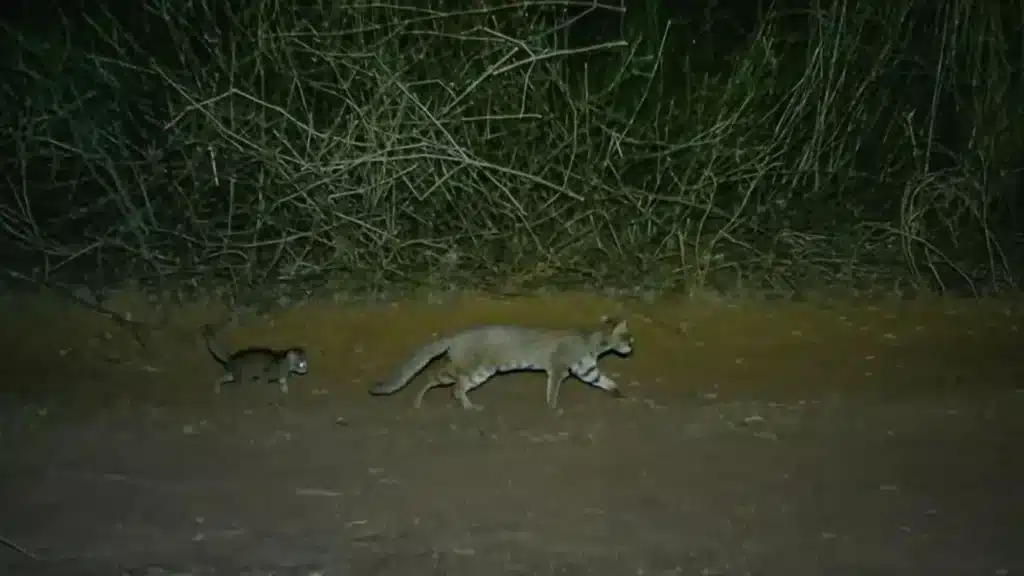
Rusty-spotted cat
- Researchers confirmed first photographic evidence of the rusty-spotted cat (Prionailurus rubiginosus), one of the world’s smallest species of wildcat in the Aravalli scrublands at the doorstep of Delhi.
- The rusty-spotted cat is classified as ‘Near Threatened’ on the IUCN Red List, and is protected under Schedule I of the Wildlife (Protection) Act.
- The rusty-spotted cat measures no more than 35-48 cm in length, about half of which is bushy tail. It has short, reddish grey fur, with rusty spots on the back and sides.
- The cat is native to India, Nepal and Sri Lanka, where almost 75% of its habitat is believed to be under threat from land-use change, including agriculture and urban expansion. The animal is rarely documented due to its secretive nature and low density.
Science and Technology
Voyager 1
- On April 17, scientists turned off the Low-energy Charged Particles experiment (LECP) to ensure Voyager 1 has more time available to continue its exploration of space beyond the solar system.
- Launched in 1977, Voyager 1 is one of the most important space missions ever undertaken.
- It was originally sent to study the outer planets, including Jupiter and Saturn, but it went far beyond its initial goal. Today, it is the most distant human-made object in space, travelling through interstellar space at high speed.
- The instrument that was powered down is known as the low-energy charged particles experiment (LECP). It has been operating almost continuously since Voyager 1 was launched in 1977.
- Over the years, the LECP has studied ions, electrons, and cosmic rays from both the solar system and interstellar space.
The Pathfinder
- Space-tech startup Pixxel on May 4, announced a partnership with LLM provider Sarvam AI to develop and build India’s first orbital data centre satellite called The Pathfinder.
- Expected to reach orbit by the end of 2026, the 200-kg satellite will house GPUs (graphics processing units) that will be used to carry out training and inference of Sarvam’s AI model.
- Unlike conventional satellite computing, which relies on low-power edge processors optimised for survival rather than performance, the Pathfinder satellite will house the same generation of hardware as on-ground data centres used to power frontier AI models.
GaN (Gallium Nitride) technology
- The Union Cabinet on May 5 approved two new semiconductor plants in India, including one that could be the country’s first display fabrication facility.
- With these, the government has approved a total of 12 chip plants under the first leg of the India Semiconductor Mission (ISM).
- Launched in 2021, ISM 1.0 was conceived as a state-backed push to build a full-stack chip ecosystem, from fabrication and packaging to design and display manufacturing.
- The recent approval is given to a Rs 3,068 crore compound semiconductor fabrication and assembly based on GaN (Gallium Nitride) technology for manufacturing Mini/Micro-LED display modules to be set up by Crystal Matrix Ltd.
- Semiconductors are made of materials such as silicon and possess a degree of electrical conductivity between that of a conductor and an insulator. Silicon has been the component mostly used in semiconductors.
- In recent years, gallium nitride (GaN), another semiconductor, is making its way into electronics as it is better suited for high power and high-frequency applications.
- Gallium Nitride is a material that is considered a better alternative to silicon. It is much better at conducting high voltage over longer times compared to silicon. It also allows electrical currents to travel faster through it.
- With lower heat, Gallium Nitride structures can be stacked closer to each other than other materials, which also means the overall structure (the charger) is smaller in size.
‘ANEEL’ fuel
- Chicago-based nuclear fuel company Clean Core Thorium Energy (CCTE) announced that its patented ‘ANEEL’ fuel has completed its high burnup irradiation test in an Advanced Test Reactor (ATR) at Idaho National Laboratory (INL).
- It is only the second American company to have secured an export license from the US Department of Energy (DAE) to sell nuclear technology to India in nearly two decades.
- CCTE has developed a thorium-based fuel, called ANEEL or Advanced Nuclear Energy for Enriched Life, that can be deployed in the country’s Pressurised Heavy Water Reactors (PHWRs) at scale.
- ANEEL is a new type of fuel that blends thorium with HALEU (high-assay low-enriched uranium) which is an important step towards the third leg of India’s 3-stage nuclear programme.
- STAGE 3 of nuclear programme: The third stage will be based on the ThU233 cycle. U233 produced in the second stage can be used for the third stage of the power programme, which consists of advanced thermal and fast breeder reactors, for long-term energy security.
- PHWRs are said to be more suited to handling thorium because heavy water – an isotope of water that has an extra neutron on the hydrogen atom – absorbs fewer neutrons during the fission process, increasing the efficiency of the fission reaction by allowing more neutrons to be absorbed by the thorium.
Drishti satellite
- An Indian start-up, GalaxEye, rode on a SpaceX rocket on May 3 to launch a first-of-its-kind satellite, aptly called Drishti.
- Drishti is the first satellite of GalaxEye, a company started by alumni of IIT Madras. It rode on a Falcon 9 rocket by SpaceX from the Vandenberg Space Force Base in California, United States, as one of the 45 payloads on the CAS500-2 mission.
- Drishti is equipped to take optical images, very much like a normal camera, as well as radar-generated images of the same place at the same time, something that has not been tried before.
- That is the reason that the company has described their innovation as Opto-SAR technology. Synthetic Aperture Radar (SAR) captures radar generated images.
- Multi-spectral images are clear and easy to understand, but they are not effective during cloudy weather or nighttime, for instance. SAR signals can penetrate clouds and take continuous images, but they are not intuitive. Like X-ray images, they need experts to glean the information.
- The uniqueness of Drishti is that it has both the sensors that will enable simultaneous imaging.
Defence
Tactical Advanced Range Augmentation (TARA) system
- The Defence Research and Development Organisation (DRDO) and the Indian Air Force (IAF) on May 7 successfully carried out the first flight trial of TARA system that can transform an unguided missile into a guided one.
- The TARA glide weapon system is primarily a modular kit that can be attached to a conventional unguided warhead. It helps the missile glide over long distances, and accurately strike a target.
- The system is believed to use a combination of inertial navigation and satellite-based positioning to steer the missile towards the target.
- The TARA system glides, rather than relying on a rocket motor. This makes it lightweight and cost-effective while still extending the missile’s range.
- Unguided bombs, which are referred to as gravity bombs or dumb bombs, can thus be upgraded to smart bombs, or precision-guided munitions, with relatively low effort. This can reduce the need to develop entirely new missile systems.
- This approach can substantially reduce costs while allowing rapid scaling of precision strike inventory.
Diseases
(Just FYI: UPSC has consistently included questions on health and diseases in its examinations over the years. For instance, in 2014, a question about the Ebola virus appeared in the Prelims, and in 2017, a question about the Zika virus was featured. Therefore, it is crucial to stay updated on diseases that are currently in the news.)
Hantavirus
- The outbreak aboard the Hondius has so far resulted in three deaths — a Dutch couple and a German national — while several others from Britain, the Netherlands, and Switzerland remain hospitalised in South Africa, Switzerland, and the Netherlands.
- Named after the Hantan River in South Korea, hantavirus is a family of rodent-borne viruses that can cause serious illness and death in humans.
- In most cases, it does not spread through casual contact between people. Still, humans run the risk of getting infected by breathing in contaminated air with rodent urine, droppings, or saliva, especially in closed or dusty spaces.
- Hantavirus infections have two main clinical presentations: Hantavirus Pulmonary Syndrome (HPS), a lung illness, and haemorrhagic fever with renal syndrome, a kidney disease.
- Symptoms can appear between one and eight weeks after exposure and may initially resemble flu-like illness, including:
- Fever
- Muscle aches
- Fatigue
- Headaches
- Chills
In severe cases, patients may develop respiratory failure and fluid buildup in the lungs.
- There is a lack of effective antiviral treatment for treating hantavirus infection. The medical approach to treatment focuses on providing supportive care — oxygen therapy, fluid management and intensive care for patients who experience severe symptoms.
Persons in News
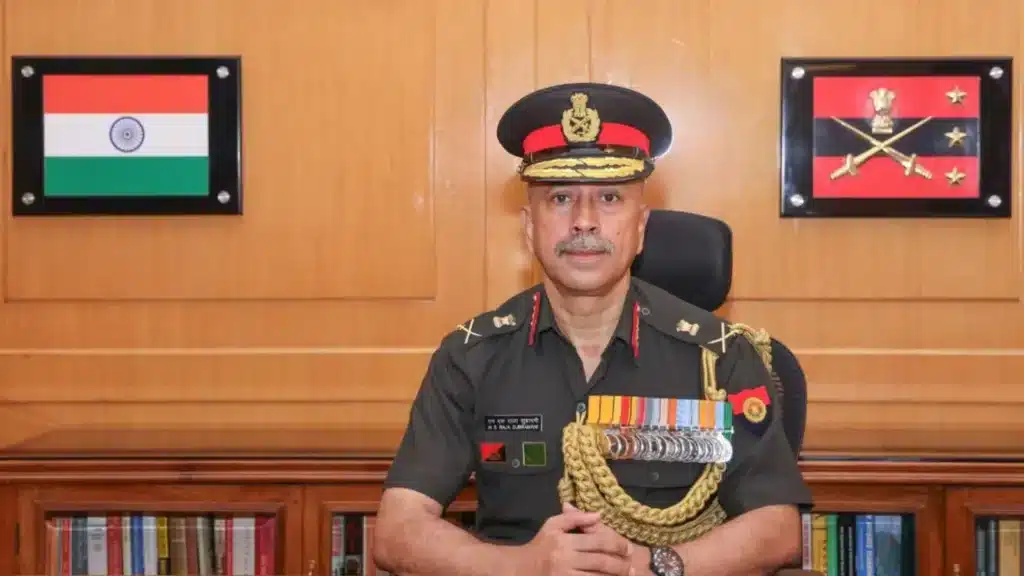
Lieutenant General N S Raja Subramani
- The Centre has appointed Lieutenant General N S Raja Subramani (Retd) as the Chief of Defence Staff (CDS), who shall also function as Secretary to the Government of India, Department of Military Affairs.
- He is the third person to assume the post after Gen Bipin Rawat and Gen Anil Chauhan.
- Vice-Admiral Krishna Swaminathan has been appointed as the next Chief of Naval Staff. He is presently the Western Naval Commander in Mumbai. He will take charge from the current CNS Admiral Dinesh Kumar Tripathi on May 31.
Tribhuvan Prasad Singh
- —A new variety of rose has been named after India’s first full-time secretary of the Planning Commission and 1936-batch ICS officer Tribhuvan Prasad Singh, better known as TP Singh.
- — “Tribhuvan”, as it is called, has been developed by South Asia’s leading nursery and rose breeder, K S Gopalaswamiengar Son, popularly known as KSG Son, at Chamarajpet, Bengaluru, over four and a half years. It is a hybrid of ‘Black Prince and Corrida’.
- — T P Singh (1913-1975), who later served as the country’s finance and agriculture secretary, is often recalled as one of leading policymakers post Independence.
Terms making buzz
Ecocide
- A recent report by Lebanon accused Israel’s military of committing “ecocide” during its 2023-24 invasion of southern Lebanon – reshaping both its “physical and ecological landscape”.
- Ecocide refers to the very worst harms caused to the environment by human actions, usually on a major industrial scale or affecting a huge area.
- The term was coined in 1970 by Prof Arthur W Galston – a Yale plant biologist whose early research contributed to the development of Agent Orange – to describe massive, long-term environmental devastation, particularly caused by the herbicide’s use in the Vietnam War.
Test Your Knowledge
(Note: The best way to remember facts for UPSC and other competitive exams is to recall them through MCQs. Try to solve the following questions on your own.)
- Consider the following statements about the World Press Freedom Index 2026:
1. Published by Reporters Without Borders (RSF).
2. It recorded its lowest average score in the index’s 25-year history.
3. India is ranked 151st.
Which of the statements mentioned above is/are correct?
(a) 1 and 2 only
(b) 2 and 3 only
(c) 1 and 3 only
(d) 1, 2, and 3 - With reference to – the White-Bellied Heron, consider the following statements:
1. It is critically endangered as per the Red List of the International Union of Conservation of Nature (IUCN).
2. Scheduled-I status of the Wildlife Protection Act.
3. Found in Arunachal Pradesh.
How many of the statements mentioned above is/are correct?
(a) Only one
(b) Only two
(c) All three
(d) None - “The crop is subtropical in nature. A hard frost is injurious to it. It requires at least 210 frost — free days and 50 to 100 centimeters of rainfall for its growth. A light well-drained soil capable of retaining moisture is ideally suited for the cultivation of the crop.” Which one of the following is that crop? (UPSC CSE 2020)
(a) Cotton
(b) Jute
(c) Sugarcane
(d) Tea
| Prelims Answer Key |
| 1. (a) 2. (c) 3. (a) |
If you missed the UPSC Current Affairs Pointers of the past few weeks : Click Below Links
UPSC Current Affairs Pointers of the past week | 27 April – 03 May 2026 read it here
UPSC Current Affairs Pointers of the past week | 20– 26 April 2026 read it here
UPSC Current Affairs Pointers of the past week | 13– 19 April 2026 read it here
UPSC Current Affairs Pointers of the past week | 06– 12 April 2026 read it here
UPSC Current Affairs Pointers of the past week | 30 March – 5 April 2026 read it here




About Author




More Stories
UPSC Current Affairs Pointers of the past week | 18–24 May 2026
UPSC Current Affairs Pointers of the past week | 11–17 May 2026
UPSC Current Affairs Pointers of the past week | 27 April – 03 May 2026