







Did you miss out on important current affairs tidbits from last week for your Prelims and Mains preparation? Here’s a checklist of the must-know facts: learn about the US National Book Critics Award, Transgender Persons Amendment Bill, India’s strategic petroleum reserves (SPRs), India’s new climate target for 2035, and more. You can also test your knowledge by solving MCQs.
UPSC Current Affairs Pointers brings you essential current affairs of the past week, every Monday, to aid you in your Prelims and Mains preparation of UPSC, State PCS, and other competitive examinations.
International Cooperation
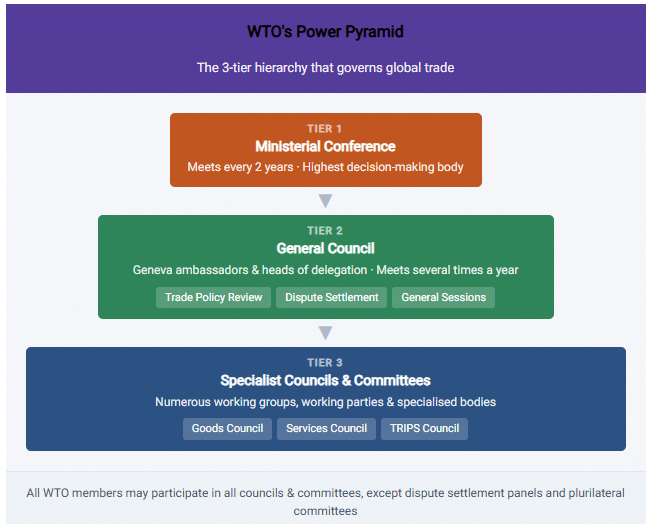
- World Trade Organisation’s 14th Ministerial Conference
— The WTO’s 14th Ministerial Conference (MC14) was held in Yaounde, Cameroon from 26th March to 29th March, 2026. The conference was chaired by Luc Magloire Mbarga Atangana, Cameroon’s Minister of Trade. The Indian delegation is led by Minister of Commerce and Industry, Piyush Goyal.
— The Ministerial Conference is the topmost decision-making body of the WTO, which usually meets every two years.
— The World Trade Organization is the only international organization that deals with the rules of trade between countries. Founded in 1995, the WTO is run by its 166 members, and according to its rules, all decisions are taken through consensus, and any member can exercise a veto.
— Dr. Ngozi Okonjo-Iweala is the seventh Director-General of the WTO. She is the first woman and the first African to serve as Director-General.
— It aims to promote free trade, which is done through trade agreements that are discussed and signed by the member states. The WTO also provides a forum for countries to negotiate trade rules and settle economic disputes between them.
— The WTO publishes the World Trade Report and Global Trade Outlook and Statistics.
- 15th meeting of the Conference of the Parties (COP 15) to the Convention on Conservation of Migratory Species (CMS)
— The 15th meeting of the Conference of the Parties (COP 15) to the Convention on Conservation of Migratory Species (CMS) of Wild Animals was held in Campo Grande, Brazil, from March 23 to March 29, 2026. The theme for this year is “Connecting Nature to sustain life.”
— The CMS is a legally binding global treaty, signed in 1979 under the United Nations Environment Programme, which aims to conserve migratory animals and their habitats across national habitats and across borders.
— Conference of the Parties is the principal decision-making body of the Convention, which meets once every three years and sets the budget and decides priorities for the following three years. At the COP, parties decide on whether to list new species or amend existing listings in the Appendices and consider reports submitted by each Party, the Scientific Council, and the Agreements established under the Convention.
— The CMS has two appendices. It is important to note that a migratory species can be listed in both the appendices.
* An Appendix I listing is for migratory species that are considered endangered. In the context of CMS, endangered refers to a species or regional population that has been assessed as Extinct in the Wild, Critically Endangered, or Endangered using the IUCN Red List of Threatened Species categories and criteria. If listed on Appendix-I, it would facilitate transboundary conservation efforts of these species.
* An Appendix II listing is for migratory species that have an unfavourable conservation status and which require international agreements for their conservation and management. A species that has been assessed as Extinct in the Wild, Critically Endangered, Endangered, Vulnerable, or Near Threatened on the IUCN Red List is eligible for consideration.
— India hosted the 13th CMS COP for the first time in 2020 and, with that, also formally assumed the role of CMS Presidency for the next three years. The theme of the COP13 was, “Migratory species connect the planet, and together we welcome them home!”
Important Day
- World Tuberculosis Day 2026
— World Tuberculosis Day is observed on March 24 every year. It aims to increase public awareness about the global epidemic of tuberculosis (TB) and the numerous efforts being taken to eliminate the disease.
— The date marks the day in 1882 when Dr. Robert Koch announced that he had discovered the bacterium that causes TB, which opened the way towards diagnosing and curing this disease.
— The theme of World TB Day 2026 is ‘Yes! We can end TB!’. It is a call to action and a message of hope, affirming that it is possible to get back on track and turn the tide on the TB epidemic, even in a challenging global environment.
— TB is caused by an organism called mycobacterium tuberculosis, which mainly affects the lungs, but can also impact other parts of the body. TB spreads through the air when an infected individual coughs, sneezes, or speaks.
— On this day, the government launched another TB Mukt Bharat Abhiyaan — 100 days’ campaign. The TB screening will be conducted using 2,000 AI-enabled hand-held X-ray devices, which AI tools can read for signs of TB, enabling early detection.
TB in numbers
The tuberculosis burden in India has continued to decline — with an estimated 27.1 lakh cases and just over 3 lakh deaths in 2024, according to the latest available data from the Global TB Report 2025. Globally, 10.7 million people fell ill and 1.23 million died in 2024, meaning India accounted for nearly a fourth of all the cases and deaths across the world.
Polity
- Supreme Court ruling on conversion
— The Supreme Court on March 24 held that a person who has converted to Christianity cannot continue to claim the protections available to the Scheduled Castes.
— The court’s ruling is essentially a reiteration of the Constitution (Scheduled Castes) Order, 1950 that bars anyone professing a religion other than Hinduism, Sikhism or Buddhism from being treated as a member of a Scheduled Caste.
— This classification is reinforced by the Constitution itself. Article 366(24) defines Scheduled Castes as those groups notified by the President under Article 341. Both provisions work in tandem, and the SC/ST (Prevention of Atrocities) Act adopts the same definitions.
— The result is that the legal identity of a person as a Scheduled Caste is inseparable from the religion they profess. Once their social membership to the community ends, the legal protections tied to it end as well.
- Transgender Persons (Protection of Rights) Amendment Bill, 2026
— This Bill was passed in the Lok Sabha on 24th March amid objections and demands from the Opposition to send it to a standing committee for further scrutiny.
— The amended Bill removes the right to gender self-identification recognised by the Supreme Court in the landmark National Legal Services Authority v. Union of India in 2014, and introduces medical certification for identity recognition.
| Transgender Persons (Protection of Rights) Amendment Bill, 2026 | Transgender Persons (Protection of Rights) Act, 2019 | |
|---|---|---|
| Definition | The definition of a transgender person under the bill is largely restrictive, recognising only one subset from the 2019 bill: Those with socio-cultural identities (kinner, hijra, aravani, jogta, eunuch) or persons born with specific congenital biological variations. | The 2019 Act defined a transgender person as one whose gender does not match the gender assigned to that person at birth. These include a bouquet of identities * Trans men and trans women, regardless of their having undergone gender-affirming (officially sex reassignment) surgery, hormone therapy or other such therapies * Persons with intersex variations * Genderqueer persons (interpreted as including non-binary identities) * Persons with such sociocultural identities as kinner, hijra, aravani and jogta |
| Self-identification | The bill does away with Section 4(2) of the 2019 Act. | Section 4(2) of the 2019 Act, enshrined the right to self-identify. |
| Medical Board for certification | The bill calls for the formation of a medical board headed by a Chief Medical Officer or a Deputy Chief Medical Officer, at the centre or state/UT level. This board will now be tasked with making recommendations to the DM, which the latter must consider, along with the advice of other medical experts where relevant, before issuing a certificate of identity. | The process of issuing transgender identity cards was administrative. A transgender person applied to the District Magistrate and received a certificate of identity, without any need for a medical examination or other clinical gate-keeping. |
| Scale of punishment | The Bill introduces four more clauses, each liable to attract rigorous imprisonment. The offence of kidnapping an adult with grievous hurt or permanent injury to force assumption of transgender identity, under the bill, will attract a minimum 10 years of RI, extendable to life, plus a minimum fine of Rs 2 lakh. Similarly, punishment for forcing an adult to present as transgender and engage in begging, servitude, or bonded labour. | The Act authorised punishments ranging from six months to two years of prison time, plus a fine, for pushing a trans person into forced or bonded labour, denying access or right of passage to a public place, forcing a trans person to leave their place of residence, household or village; and for causing harm, injury, or endangerment — physical, mental, sexual, verbal, emotional, or economic. |
- Central Armed Police Forces (General Administration) Bill, 2026
— The Centre has introduced the Central Armed Police Forces (General Administration) Bill, 2026, in the Rajya Sabha.
— The Bill defines the Central government as the Ministry of Home Affairs, the administrative ministry of all five CAPFs — the Border Security Force (BSF), the Central Reserve Police Force (CRPF), the Central Industrial Security Force (CISF), the Indo-Tibetan Border Police (ITBP), and the Sashastra Seema Bal (SSB).
— According to the Bill, 50% of the posts are to be filled by deputation in the rank of IG, and a minimum of 67% of the posts at Additional DG rank will be filled by deputation. The posts in the ranks of Special DG and DG shall be filled exclusively by deputation.
— The Bill, if passed, is likely to effectively undo a Supreme Court verdict directing the Centre to progressively reduce the deputation of IPS officers in the CAPFs.
— On May 23, 2025, the Supreme Court directed a progressive reduction in the deputation of IPS officers in the CAPFs to the posts of DIG (Deputy Inspector General of Police) and IG (Inspector General) within a period of two years.
- UDAN 2.0
— The Union Cabinet has approved the Regional Connectivity Scheme – Modified UDAN, allocating Rs 28,840 crore for its implementation over the next ten years.
— It is scheduled to run from fiscal year 2026-27 to 2035-36.
— UDAN (Ude Desh ka Aam Naagrik) is an initiative by the government to connect the country’s under-served and unserved airports.
Economy
- India’s strategic petroleum reserves (SPRs)
— The Ministry of Petroleum and Natural Gas (MoPNG) said in the Rajya Sabha on March 23 that India’s SPRs, which have a capacity to store 5.33 million tonnes of crude oil, are currently holding 3.37 million tonnes of oil, or just about two-thirds of their total storage capacity.
— The SPRs are meant to act as a buffer for short-term supply shocks. At full capacity, the three SPRs cover around 9.5 days of India’s crude oil supplies.
— India has SPRs at three locations in Andhra Pradesh and Karnataka. These are underground caverns at Visakhapatnam, Andhra Pradesh (1.33 million tonnes); Mangaluru, Andhra Pradesh (1.5 million tonnes); and Padur, Karnataka (2.5 million tonnes).
— The concept of dedicated strategic reserves was first mooted in 1973, after the first oil crisis. Western strategic reserves have been tapped during the first Gulf War (1991), after Hurricane Katrina (2005), and in 2022 after global oil prices surged in the wake of Russia’s invasion of Ukraine.
— In India, ISPRL (Indian Indian Strategic Petroleum Reserve) is the special purpose vehicle as a wholly-owned subsidiary of the Oil Industry Development Board tasked for building and managing the strategic crude storage.
— The International Energy Agency (IEA) recommends that countries should hold oil stocks equivalent to at least 90 days of their net oil imports. IEA members are obligated to maintain these levels of reserves; India is not a full member of the grouping but an associate member.
— The current total national capacity for storage of crude oil and petroleum products is 74 days, including commercial stocks with refiners; it is still lower than what the IEA recommends.
- Supply disruption of Helium
— The disruption in the global supply of helium because of the war in the Middle East and the severe restrictions on trade through the Gulf of Hormuz has begun to ring alarm bells in India’s healthcare sector, especially with regard to the cost of magnetic resonance imaging (MRI) scans and the installation of MRI machines.
— Even though it has not reached an outright disruption in supply of helium,the supply disruptions, especially from Qatar, which supplies about a third of the world’s helium exports, have driven up prices significantly.
— Helium, a colourless, odourless, gas – the first of the six noble gases in the periodic table – is a non-renewable resource which, despite being the second most abundant element in the universe after hydrogen, is rare on Earth.
— Helium is produced commercially by extracting it from natural gas by a process known as cryogenic distillation. Qatar is the world’s third largest exporter of natural gas after the United States and Russia.
— Helium is critical for operating MRI machines. Helium in its liquid state is used to cool the intensely powerful superconducting magnets that are at the heart of MRI machines.
Environment
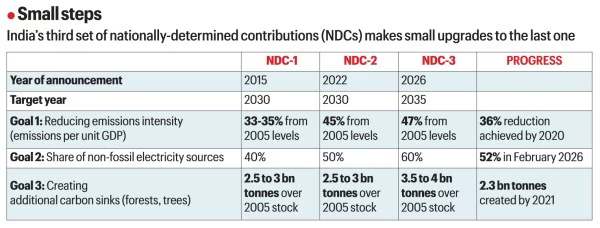
- India’s climate targets for the year 2035
— India has announced its climate targets for the year 2035, making modest upgrades in its three existing commitments for 2030.
— In the new targets India has promised to attain at least 47 per cent reduction in emission intensity of its GDP (emission per unit of GDP) from 2005 baseline by 2035. Its current commitment, for the year 2030, is to achieve a 45 per cent reduction.
— By the year 2020, the last year for which emission intensity data has been published, India had already achieved a 36 per cent reduction over 2005 levels.
— India has also promised to ensure that at least 60 per cent of its total electricity generation capacity would comprise non-fossil fuel sources by 2035. The existing target for 2030 was 50 per cent, which has already been achieved well ahead of schedule.
— India’s third commitment relates to creation of additional capacity in its forests to absorb carbon dioxide. For 2035, India is targeting to enlarge this to 3.5 to 4 billion tonnes of CO2 equivalent.
— This is India’s third nationally-determined contribution (NDCs), the first two having been submitted in 2015, pertaining to the year 2025, and then in 2022, for the year 2030.
— Each of the new targets marks a progression over existing commitments for 2030, a mandatory requirement under the 2015 Paris Agreement.
— Under this 2015 pact, every country is obligated to decide upon, and implement a set of climate actions that help the global fight against climate change. These are referred to as NDCs— emphasising the fact that countries themselves decide the nature and scale of climate actions.
- “Smog-eating” photocatalytic coatings
— As a part of a six-month collaboration between the Delhi government and IIT Madras, scientists are testing whether “smog-eating” photocatalytic coatings when applied on roads, pavements, and tiles, can dismantle key air pollutants and clean Delhi’s foul air.
— They have to test whether “smog-eating” photocatalytic coatings on public spaces could reduce pollutants such as nitrogen dioxide (NO₂) and volatile organic compounds (VOCs), both key drivers of urban air pollution.
- Great Indian Bustard
— For the first time in a decade, Gujarat saw the birth of a Great Indian Bustard (GIB) chick on March 26. This is the country’s first birth of the critically endangered bird under the “jumpstart” method, where a female GIB in Kutch, which had laid an infertile egg, incubated a fertile egg chosen from a captive breeding centre in Jaisalmer.
— This is a significant development for the GIB conservation programme. Gujarat has only three surviving GIBs in the wild, and all are female. Hence, their eggs are all infertile.
— There are only an estimated 150 GIBs in the wild in the country, mostly in Rajasthan. The large bird, a key indicator species of the grassland habitat, has faced population decline over the years due to hunting, habitat loss, and, in recent years, collisions with energy transmission lines that criss-cross their habitat in Rajasthan and Gujarat.
Conservation status of GIB
IUCN Red List status of Great Indian Bustard: Critically Endangered
Wildlife Protection Act, 1972: Schedule I
Convention on the Conservation of Migratory Species of Wild Animals (CMS): Appendix I
Convention on International Trade in Endangered Species of Wild Fauna and Flora (CITES): Appendix 1
Science and Technology
- Tunnel Boring Machine (TBM)
— The 3,000-tonne Tunnel Boring Machine (TBM), supplied by German company Herrenknecht, for India’s maiden bullet train project has arrived in Mumbai.
— It marked a major step forward for the 21-km tunnel stretch of the Mumbai-Ahmedabad High Speed Rail (MAHSR) project.
— Of the 508-km bullet train project, tunnels account for 27.4 km. Of this, 21 km comprises underground tunnels, while 6.4 km consists of surface tunnels.
Places in News
(Just FYI: The location of the place is important, considering that UPSC has asked several questions about places that were in the news, such as Aleppo and Kirkuk, in the 2018 UPSC Prelims. The best way to remember them is to plot them on a world map.)
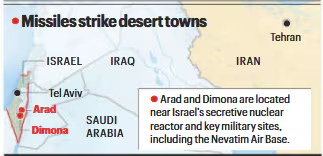
- Dimona and Arad
— In the ongoing war in West Asia, Iranian missiles struck the Israeli city of Dimona, close to one of Israel’s key nuclear facilities, and nearby Arad. The strike in Arad alone injured 84 people.
— The Iranian barrage came hours after the US and Israel struck Tehran’s Natanz nuclear facility for the second time in the ongoing war.
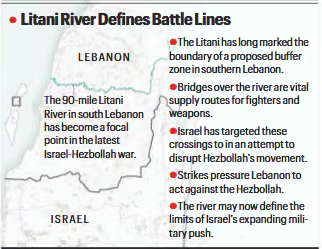
- Litani River
— Israel struck a main bridge linking Lebanon’s south to the rest of the country after ordering its military to destroy all crossings over the Litani River and to step up the demolition of homes near the southern border.
— According to the National Litani River Authority, “Litani River is the longest and largest river in Lebanon, with a length of 170 km, and its water capacity is approximately 750 million cubic meters per year.”
— “It originates from several springs called Al-Aleeq Springs, located at a distance of ten kilometers to the west of the city of Baalbek, at an altitude of one thousand meters.”
- Diego Gracia
— Iran has fired two ballistic missiles at Diego Garcia Island, a joint US-UK Indian Ocean base, in its longest attack since the outbreak of war in West Asia.
— Diego Garcia lies in the central Indian Ocean, south of India and southwest of Sri Lanka. It is the largest island in the Chagos Archipelago and one of only two critical US bomber bases in the Indo-Pacific region, the other being Andersen Air Force Base in Guam. The base hosts bombers, nuclear submarines, and guided-missile destroyers.
— Diego Garcia sits approximately 3,000 km from both the Bab-el-Mandeb Strait at the mouth of the Red Sea and the Malacca Strait near the South China Sea. This strategic location allows long-range bombers to reach the two critical maritime chokepoints. The base is also critical to US Space Force tracking infrastructure.
Awards
- US National Book Critics Circle Award 2026
— Indian Booker-winning novelist Arundhati Roy was awarded the United States National Book Critics Circle award for her memoir, Mother Mary Comes to Me in the Autobiography section.
— Mother Mary Comes to Me has been published in the United States by Scribner (now a part of Simon & Schuster), which has a legacy of publishing literary giants such as Ernest Hemingway, F Scott Fitzgerald, and Stephen King.
— South Korean Nobel laureate Han Kang won the fiction honour for her novel, We Do Not Part.
— Karen Hao, a journalist, took home the nonfiction prize for her investigation, Empire of AI: Dreams and Nightmares in Sam Altman’s OpenAI, which examines the company behind ChatGPT, whose reach and capabilities have been a subject of intense public debate around the globe, while Neige Sinno won the translation prize for Sad Tiger, which was rendered into English from the French by Natasha Lehrer.
— The National Book Critics Circle, founded in New York in 1974, comprises more than 850 critics and editors and each year honours the best books published in the United States.
— The book was also shortlisted for the 2026 Women’s Prize for Non-Fiction. The winner will be announced on 11 June 2026 at the Women’s Prize Trust’s summer party in London, receiving £30,000 and a limited-edition sculpture.
Sports
- SRY gene screening
— The International Olympic Committee (IOC) has added that athletes wanting to compete in the female category at the Olympics would have to undergo a one-time SRY gene screening. This would also apply to biological females. The SRY gene screening would be done via saliva, cheek swab or blood sample, the IOC said, adding that they are ‘unintrusive compared to other possible methods.’
— SRY stands for ‘sex determining region Y’. The SRY gene is a segment of DNA that is almost always on the Y chromosome, signalling the presence of testes/testicles and “initiating male sex development by the production of testosterone”, the IOC said.
— It has banned transgender women and DSD (Differences in Sex Development) athletes from competing in the female categories at the 2028 Los Angeles Olympics and beyond.
Test Your Knowledge
(Note: The best way to remember facts for UPSC and other competitive exams is to recall them through MCQs. Try to solve the following questions on your own.)
(1) Consider the following statements:
1. India hosted the 13th COP of the Conservation of Migratory Species (CMS) in 2020.
2. CMS has two appendices.
3. Species listed in one appendix can be listed in another.
4. The Bengal Florican and the Asian Elephant are listed as Appendix I of the CMS.
Which of the statements mentioned above is/are correct?
(a) 1 and 3 only
(b) 2 and 4 only
(c) 1, 2, and 4 only
(d) 1, 2, 3, and 4
(2) The SRY gene screening seen recently in the news is in which context?
(a) Test to verify the biological sex of athletes entering the female category
(b) Test the rare diseases impacting a child due to the mother’s chromosomes
(c) Test the rare diseases impacting a child due to the father’s chromosomes
(d) New policing tool to aid in forensic screening
(3) Which one of the following groups of animals belongs to the category of endangered species? (UPSC CES 2012)
(a) Great Indian Bustard, Musk Deer, Red Panda and Asiatic Wild Ass
(b) Kashmir Stag, Cheetal, Blue Bull and Great Indian Bustard
(c) Snow Leopard, Swamp Deer, Rhesus Monkey and Saras (Crane)
(d) Lion-tailed Macaque, Blue Bull, Hanuman Langur and Cheetal
| Prelims Answer Key |
| 1. (d) 2. (a) 3. (a) |




About Author





More Stories
Hunk of Knowledge | Gold in spotlight: Understanding price trends, its uses, and distribution