Are you preparing for the UPSC CSE Prelims 2026? Don’t miss out on important current affairs tidbits. Learn about the premature release, model code of conduct, Overseas Citizen of India card, marine spatial planning, Athletics Federation of India and more.
Reports
(FYI: The data provided in these reports can be used to substantiate your Mains answer and create a broad understanding of the topic.)
New study on use of tobacco by the households
- A new study published in the British Medical Journal (BMJ) Global Health, found that over 20.49 million households – 10.6% of all households in the country — could rise to a higher economic class just by stopping spending on tobacco and redirecting that money to other needs.
- The poorest households spend 6.4% of their entire monthly income on tobacco, the study found.
- India carries one of the world’s largest tobacco burdens. With over 267 million tobacco users, which is nearly a quarter of the adult population, tobacco is the single largest preventable cause of death and disease in the country, responsible for over a million deaths every year.
- Its established links to cancers of the mouth, throat, lung, and oesophagus as well as to heart disease and stroke, have long made it a central concern of public health policy.
Extreme events could impact 36% of land animal habitats by 2085, says new study
- By 2085, over a third of wildlife habitats on land could suffer multiple types of climate-driven extreme weather events, such as heatwaves, wildfires, and floods, if warming continues to rise in the second half of the century, according to a new study published in the Nature Ecology & Evolution journal.
- The study, led by researchers at the Potsdam Institute for Climate Impact Research (PIK), Germany, analysed the impact of climate change in a medium-high emission scenario on nearly 34,000 vertebrate species.
- The most widespread impact will be from extreme heatwaves, the study found. By 2050, 74% of animal habitats on land will be exposed to heatwaves, 16% to wildfire, 8% to droughts, and 3% to floods if warming continues into the latter half of the century, the study said.
Polity


Judges recuse
- Justice Swarana Kanta Sharma of the Delhi High Court has refused to recuse from hearing a high-profile criminal revision petition arising out of the Delhi excise policy case, laying down a detailed, almost personal defence of judicial independence and institutional integrity.
- When there is a conflict of interest, a judge can withdraw from hearing a case to prevent creating a perception that she carried a bias while deciding the case.
- The practice stems from the cardinal principle of due process of law that nobody can be a judge in her own case. Any interest or conflict of interest would be a ground to withdraw from a case since a judge has a duty to act fair.
- Another instance for recusal is when an appeal is filed in the Supreme Court against a judgement of a High Court that may have been delivered by the SC judge when she was in the HC.
- There are no formal rules governing recusals, although several Supreme Court judgments have dealt with the issue. Since, there are no formal rules, it is often left to individual judges to record reasons for recusal.
- In Ranjit Thakur v Union of India (1987), the Supreme Court held that the test of the likelihood of bias is the reasonableness of the apprehension in the mind of the party.
- Once a request is made for recusal, the decision to recuse or not rests with the judge. There have been several cases where judges have refused to withdraw from a case.
Premature Release
- The Delhi High Court on April 16, 2026 criticised the Sentencing Review Board’s (SRB) latest rejection of Santosh Kumar Singh’s plea for premature release.
- The SRB, comprising senior state officials, including the DG of Prisons, the Police Commissions, and the Chief Secretary, is the body that must first examine each case and pass its recommendation to the government.
- Premature release allows life convicts to be released early if they are deemed to be reformed, rehabilitated and no longer a threat to society. The powers of clemency are derived from both constitutional and statutory frameworks.
- Section 473 of the BNSS (and Section 432 of the CrPC) grants state governments the power to remit sentences “at any time”.
- This is separate from the power of the President and the Governor to remit sentences under Articles 72 and 161 of the Constitution respectively.
- One of the restraints placed on the state government’s power of remission can be found under Section 475 of the BNSS (and Section 433A of the CrPC). For convicts serving a life sentence and have been found guilty of an offence punishable by death, the state cannot release them from prison until at least 14 years imprisonment have been served.
Congress moves privilege notice against PM Modi
- The Congress on 21st April moved a privilege notice against Prime Minister Narendra Modi for allegedly “having cast aspersions” on the “independence and integrity” of elected Members of Parliaments during his address to the nation on 18th April night.
- Parliamentary privileges are certain rights conferred to the MP for conducting the business of the Parliament. There is no codified list of the exact privileges, but it includes the right of free expression in the course of Parliamentary debates and MP will not be liable for court proceedings for this.
- According to the Constitution of India, Articles 105 and 122 outline the privileges of Parliament, while Articles 194 and 212 pertain to the privileges of state governments.
- If there is a belief that such a privilege has been breached, a motion can be raised by any member. It can be admitted by the Chairman. They can then refer it to the Privileges Committee.
Committee of Privileges
It examines all questions involving breach of certain rights, privileges, and immunities enjoyed by MPs. It is a Standing Committee. It examines the cases of breach of the privileges of the House and its members and recommends appropriate action. The Lok Sabha committee has 15 members, while the Rajya Sabha committee has 10 members.
Corporate Social Responsibility (CSR)
- Corporate Social Responsibility (CSR) spending by companies listed on stock exchanges registered a sharp rise of 23% in FY25, reaching Rs 22,212 crore compared with Rs 18,011 crore in the previous financial year. The increase has been attributed largely to robust corporate profitability.
- CSR is a management framework through which companies incorporate social and environmental considerations into their business operations and interactions with stakeholders. It represents a long-term, structured commitment to societal development and welfare.
- According to the National CSR Portal, “Ministry of Corporate Affairs had issued ‘Voluntary Guidelines on Corporate Social Responsibility, 2009′ as a first step towards mainstreaming the concept of Business Responsibilities.
- This was further refined subsequently, as ‘National Voluntary Guidelines on Social, Environmental and Economic Responsibilities of Business, 2011‘.”
- Later, the Companies Act, 2013, made it mandatory for listed and unlisted organisations of a certain size and net worth to spend at least 2 per cent of their average net profit towards CSR.
The Mahanadi river dispute
- The Mahanadi originates in Chhattisgarh’s Dhamtari district and flows through Odisha, finally draining into the Bay of Bengal. It is a key river system in the region and has led to water-sharing disputes between the states since 2016.
- Odisha has alleged that Chhattisgarh has “unilaterally constructed” at least eight barrages along the river, which have impacted its flow into the state during the non-monsoon period. Odisha has termed the river a lifeline for the state, given its significance for agriculture, fisheries and power generation. According to official data, Mahanadi has a total catchment area of 1,41,600 sq km, of which 45.73% falls in Odisha, 53.9% in Chhattisgarh and a small patch in Madhya Pradesh.
- Chhattisgarh, on the other hand, has argued that given the large catchment area in the state, it was within its rights to use the river water. Chhattisgarh also pointed out that Odisha had commenced certain major and medium projects without informing it as the upper riparian State.
- Almost six months after Odisha and Chhattisgarh agreed on an “amicable solution” to resolve the long-pending Mahanadi water dispute, the tribunal formed to adjudicate the matter has given the states a last opportunity to devise a settlement formula.
- In its April 20 order, the Mahanadi Water Dispute Tribunal (MWDT) warned that it will proceed on merits if the two states are unable to finalise the settlement formula and ‘place on record’ any consensus on the issues by May 2.
- Headed by former Supreme Court judge Justice Bela M Trivedi, the tribunal also expressed its displeasure with the manner in which the proceedings of the references are being conducted.
Model Code of Conduct
- The Election Commission of India will “examine” the Opposition’s complaint against Prime Minister Narendra Modi that his address to the nation on April 18 was violative of the Model Code of Conduct, sources said on Tuesday (April 21).
- The Election Commission’s Model Code of Conduct is a set of guidelines issued to regulate political parties and candidates prior to elections. The rules range from issues related to speeches, polling day, polling booths, portfolios, content of election manifestos, processions and general conduct, so that free and fair elections are conducted.
- The MCC comes into force from the date the election schedule is announced until the date that the results are out.
International Cooperation
India-South Korea
- President of South Korea, H.E. Lee Jae Myung, was on a state visit to India from 19-21 April 2026.
- India and South Korea have signed four MoUs for cooperation in the fields of Sports, Cultural and Creative Industries, Small and Medium Enterprises and for the establishment of the Industrial Cooperation Committee.
- During the visit, the Republic of Korea formally joined the International Solar Alliance and the Indo-Pacific Oceans Initiative.
- The bilateral trade between India and Korea has reached 27 billion dollars, and they have targeted to increase the bilateral trade to 50 billion dollars by 2030.
Overseas Citizen of India (OCI) card
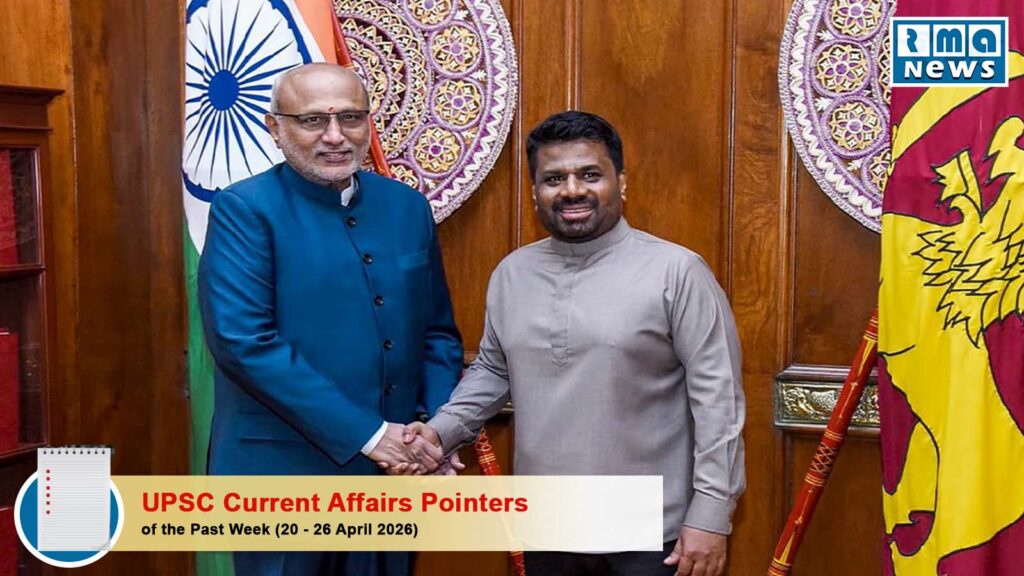
- During the official visit to Sri Lanka, Vice-President C P Radhakrishnan on April 19 announced the extension of the eligibility for Overseas Citizen of India (OCI) card for the Indian community in the island nation till the sixth generation. Until now, this was limited to the fourth generation.
- Introduced in August 2005, the OCI scheme provides for registration of all Persons of Indian Origin (PIOs) who were citizens of India on January 26, 1950, or thereafter, or were eligible to become citizens of India on the said date.
- It was introduced by amending the Citizenship Act, 1955, in August 2005. The Scheme was launched during the Pravasi Bharatiya Divas convention 2006 at Hyderabad. In 2015, the government discontinued the PIO scheme, and PIO cardholders were required to convert to OCI.
- An applicant is not eligible to get an OCI card if his/her parents or grandparents have ever been citizens of Pakistan or Bangladesh. However, the spouse of foreign origin of a citizen of India or spouse of foreign origin of an OCI, whose marriage has been registered and subsisted for not less than two years, can apply for an OCI card.
Economy
Paytm Payments Bank
- More than two years after barring Paytm Payments Bank from accepting deposits or top-ups, the Reserve Bank of India (RBI) recently scrapped its banking licence with immediate effect.
- The central bank said the bank’s operations were conducted in a way that was “detrimental to the interest of the bank and its depositors.”
- Paytm Payments Bank has been under regulatory scrutiny since 2018 owing to multiple compliance concerns. The central bank identified violations related to know-your-customer (KYC) norms — rules designed to verify customer identities and prevent financial fraud.
- One of the key issues flagged by the RBI was that the bank had linked a single Permanent Account Number (PAN) to multiple customer accounts. This raised serious red flags, as such practices can potentially be used to bypass regulatory safeguards.
Additionally, the RBI observed that the bank was allowing transactions beyond the prescribed limits for certain accounts, which heightened concerns around possible money laundering risks. - Payments banks in India are tightly restricted — they can accept deposits only up to Rs two lakh per customer and are not allowed to offer loans or credit cards.
Environment
Marine Spatial Planning
- Odisha became the first state to launch the Marine Spatial Planning (MSP) in the second phase for integrated coastal and marine planning.
- It was launched after the Odisha government signed a memorandum of understanding with the National Centre for Coastal Research (NCCR) under the Union Ministry of Earth Sciences.
- Sustainable ocean planning has been underway in India since 2019, with collaboration between India and Norway. In the first phase, it was taken up in two Union territories, Puducherry and Lakshadweep.
- The MSP is a tool for sustainable and integrated ocean management aimed at boosting the blue economy and strengthening climate resilience.
- In August 2025, the Odisha government also launched the Odisha Marine Biotechnology Research and Innovation Corridor (OMBRIC) to promote the use of biotechnology for marine environmental protection and economic development.
AMOC, or Atlantic Meridional Overturning Circulation
- It is part of a giant loop of water that snakes through the world’s oceans. It carries warm, salty water from the tropical Atlantic up past the Eastern Seaboard and toward Europe. There, the water releases its heat into the air and helps moderate the weather in Britain and the Nordic countries.
- In the process, the water cools, sinks and heads back south, where it goes on to influence rainfall patterns in Africa, South America and beyond.
- In a study published Friday in the journal Science Advances, researchers show that, under certain conditions, building a 50-mile-long dam across the Bering Strait—the shallow waterway that separates Russia and Alaska—could prevent a collapse of the AMOC, which plays a central role in regulating Earth’s climate.
- The AMOC (pronounced AY-mock) has weakened in recent decades, and a growing body of evidence suggests human-caused warming could someday cause it to shut down or slow significantly, with grave effects on the weather on multiple continents.
- Warming from greenhouse gases in the atmosphere is disrupting this vast oceanic conveyor belt. As temperatures rise, the Arctic gets rainier and Greenland’s ice sheet melts, more fresh water is pouring into the North Atlantic, making its surface less salty. That prevents the water of the AMOC from sinking at the loop’s northern end, which in turn causes it to draw less warm water northward from the tropics.
- Should the belt stop turning altogether, Northern Europe would grow colder, deprived of the warmth the AMOC brings. With less water moving north through the Atlantic, more of it would slosh toward the U.S. East Coast, raising sea levels there. Tropical rainfall patterns would be rearranged, parching some areas while dousing others.
Security Issues
US Secret Service
- A man armed with multiple weapons stormed through a security checkpoint at the Washington Hilton hotel, which hosted the annual White House Correspondent Dinner with US President Donald Trump on April 25.
- The episode has raised concerns about political violence in the US, coming after multiple security incidents involving Trump, in particular. Less than two years ago, he was shot at in a campaign rally, which led to the resignation of the then Director of the US Secret Service, Kimberly Cheatle.

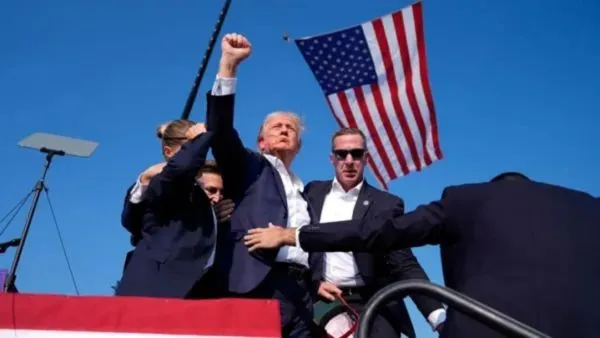
- The Secret Service is the agency primarily tasked with protecting the US president. But this was not always the case; in fact, the agency was initially founded to combat counterfeiting of US currency. Today, it is best associated with sunglasses-wearing agents and the armoured limousine attached to the president, called The Beast, but its day-to-day role involves a large number of complex tasks.
- It was founded in 1865 and is one of the world’s oldest federal investigative law enforcement agencies. Its mandate changed after President William McKinley’s killing, who was the third US president assassinated after Abraham Lincoln and James A Garfield in 1865 and 1881, respectively.
- It assumed full-time responsibility for the safety of the US president in 1902. It works under the Department of Homeland Security and “employs approximately 3,200 special agents, 1,300 Uniformed Division officers, and more than 2,000 other technical, professional and administrative support personnel”, according to its website.
SPG
In India, the Special Protection Group (SPG) was established in 1985 — a year after the assassination of Prime Minister Indira Gandhi — to provide security cover to the Prime Minister, former Prime Ministers and their immediate family members. They work in collaboration with the Intelligence Bureau and local police forces.
Science and Technology
Narcotics Analysis & RAG-based Investigation Tool (NARIT-AI)
- The Gujarat Police has developed the NARIT-AI tool to help police make tighter cases under the Narcotics Drugs and Psychotropic Substances (NDPS) Act to ensure conviction.
- The tool, designed to help law enforcement agencies in handling complex narcotics cases under the NDPS framework.
- It will integrate legal provisions, case laws, and investigative procedures to provide real-time analytical support to investigating officers (IOs).
- NARIT-AI was developed using Retrieval-Augmented Generation (RAG) technology.
- RAG is an AI framework that improves the accuracy of a large language model (LLM) by referencing trusted knowledge bases before generating responses, which in this case are laws, circulars, cases, and judgments on narcotics cases in India.
India’s first advanced 3D chip packaging unit
- The foundation stone for India’s first advanced 3D chip packaging unit was laid in Bhubaneswar, in a big boost to India’s growing semiconductor ambitions.
- The project is being implemented by the US-based 3D Glass Solutions Inc through its wholly owned Indian subsidiary Heterogeneous Integration Packaging Solutions Pvt Ltd. It is funded by Intel, among others. Intel’s CEO Lip-Bu Tan joined the ceremony virtually.
- 3D glass semiconductor technology is an advanced chip process that utilises specialised glass substrates to enable high-performance, three-dimensional integration of electrical components.
- Unlike traditional silicon, glass offers superior radio frequency performance, lower electrical loss, and enhanced thermal stability for passive component integration. The plant in Bhubaneswar will assemble and package these chips.
Defence
China’s new Atlas drone swarm system
- Chinese People’s Liberation Army (PLA) unveiled its new Atlas drone swarm system (atelasi). The one-of-a-kind system combines features like simultaneous mass launch, control of nearly 100 drones, and a single human touchpoint to control them all.
- The system is like a mini-battlefield network on wheels, where drones are truck-launched, remotely navigated by a single operator, and capable of scouting, communicating, confusing, and attacking defence across a large perimeter. More importantly, it is a very small, independent unit that is easy to hide, camouflage, and operate from remote corners.
- China Electronic Technology Group Corporation (CETC) (zhongguo dianzi keji jituan gongsi), established in 2002, one of the leaders of China’s push for achieving civil-military integration, has manufactured the Atlas system.
- The Atlas system can simultaneously launch up to 96 small- and medium-sized speed drones that can form defensive structures and precision formations, both to defend and attack.
- The launch time between drones is less than three seconds. Thus, within 300 seconds, the system can launch all 96 drones for an attack, reconnaissance, or to confuse the adversary. For context, amid the recent West Asia war, the US advanced E-3 Sentry AWACS aircraft at the Prince Sultan Airbase in Saudi Arabia was destroyed by a swarm of 29 drones and a few ballistic missiles.
FYI
Currently, China’s Atlas system, at least theoretically, outpaces and outsmarts all its competitors.
Purely on scale, the US Department of War’s “Perdix” and Defense Advanced Research Project Agency’s “Offset” systems can launch 103 micro-drones and 250 unmanned systems, respectively. Even China’s “mothership” (Jiu Tian) can launch up to 100-150 drones. But Atlas stands out for its intelligence because, in modern military warfare, counting drones within the swarms is an outdated metric.
The real victory lies in the cognitive test: can these 90 to 100 drones think individually and as a unit, reroute, identify, reidentify targets, and execute multiple strikes — all with only a single human touchpoint. It is here that the Atlas Drone Swarm system outshines all its competitors, at least theoretically.
Sports
(Just FYI: With the unpredictability of the UPSC examinations and questions like the ICC World Test Championship question 2021, you can’t be sure of anything. It is wise to know what it is and not go into too much detail.)
Athletics Federation of India (AFI)
- The Athletics Integrity Unit (AIU) Board, an autonomous body set up by World Athletics, has downgraded the Athletics Federation of India (AFI), flagging concerns over the “extremely high” doping risk among athletes in the country.
- AFI has been downgraded to Category A, the highest-risk bracket for doping in international athletics.
- It means India’s track and field athletes will now have to comply with more stringent anti-doping stipulations, with all national team members having to undergo tests before major championships.
- Between 2002 and 2025, India was among the top two in the list of countries with the most Anti-Doping Rule Violations (ADRVs) in athletics, according to data presented in the AIU statement.
Person in News
Ashok Kumar Lahiri
- The government has reconstituted the NITI Aayog, appointing Ashok Kumar Lahiri as its vice chairman and four new full-time members.Lahiri, a former Chief Economic Advisor (CEA) and a member of the 15th Finance Commission, will take over from Suman Bery, whose term ends later this month.
- NITI Aayog is composed of a Chairperson (Prime Minister), a Vice-Chairperson appointed by the PM, a Governing Council (CMs of all states and Lt. Governors of UTs), and a Chief Executive Officer.
- According to Niti Aayog’s official website, “NITI Aayog serves as the apex public policy think tank of the Government of India, and the nodal agency tasked with catalysing economic development and fostering cooperative federalism through the involvement of State Governments in the economic policymaking process using a bottom-up approach.”
John Ternus
- Apple has named John Ternus as its new chief executive to take over from Tim Cook, who is stepping down after 15 years of leading the technology major. Cook has been at the helm since 2011 after co-founder Steve Jobs resigned for health reasons, just before his passing. Ternus, who is currently the head of hardware engineering, will take over on September 1.
Test Your Knowledge
(Note: The best way to remember facts for UPSC and other competitive exams is to recall them through MCQs. Try to solve the following questions on your own.)
- With reference to Corporate Social Responsibility (CSR) rules in India, consider the following statements: (UPSC CSE 2024)
1. CSR rules specify that expenditures that benefit the company directly or its employees will not be considered as CSR activities.
2. CSR rules do not specify minimum spending on CSR activities.
Which of the statements given above is/are correct?
(a) 1 only
(b) 2 only
(c) Both 1 and 2
(d) Neither 1 nor 2 - With reference to the Model Code of Conduct (MCC), consider the following statements:
1. It is a set of guidelines issued to regulate political parties and candidates prior to elections.
2. The MCC was first introduced in the state assembly elections in Karnataka.
3. It does not contain provisions dealing with election manifestos.
How many of the statements given above are correct?
(a) Only one
(b) Only two
(c) All three
(d) None
| Prelims Answer Key |
| 1. (a) 2. (a) |
If you missed the UPSC Current Affairs Pointers of the past few weeks : Click Below Links
UPSC Current Affairs Pointers of the past week | 13– 19 April 2026 read it here
UPSC Current Affairs Pointers of the past week | 06– 12 April 2026 read it here
UPSC Current Affairs Pointers of the past week | 30 March – 5 April 2026 read it here
UPSC Current Affairs Pointers of the past week | 23– 29 March 2026 read it here
UPSC Current Affairs Pointers of the past week | 16– 22 March 2026 read it here