With INS Aridhaman’s induction, India will have three operational ballistic missile submarines at sea for the first time.
India Friday inducted its third nuclear-powered ballistic missile submarine (SSBN), INS Aridaman, significantly strengthening its sea-based nuclear deterrent capabilities. Additionally, the Indian Navy also commissioned the advanced stealth frigate INS Taragiri at a separate ceremony.
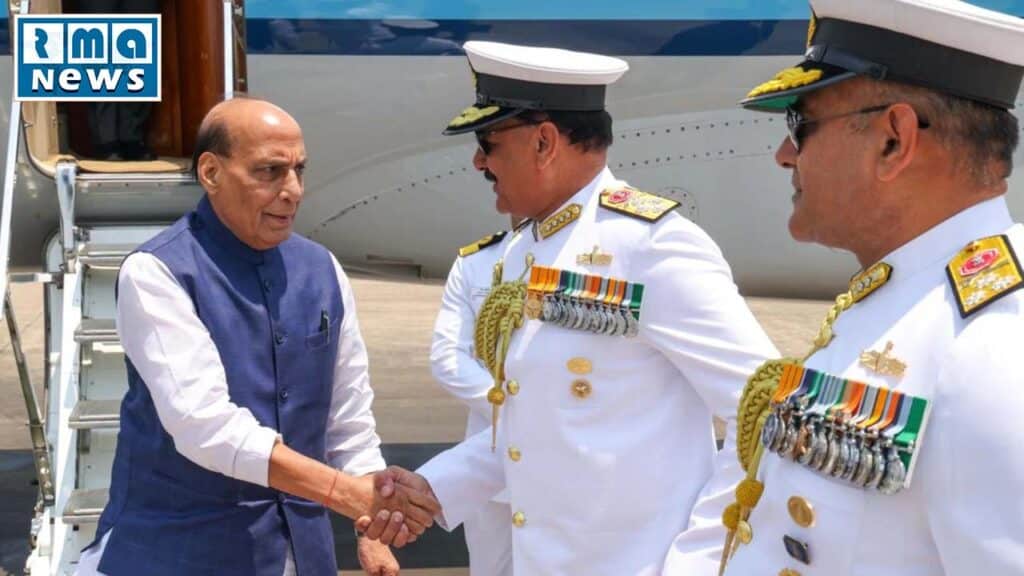
Defence Minister Rajnath Singh presided over both the commissioning ceremonies.
While there is no official word yet on the commissioning of INS Aridaman, Singh, in a cryptic post on X Friday morning, described the SSBN as “not words, but power.”
With INS Aridaman’s induction, India will have three operational ballistic missile submarines at sea for the first time. The indigenous SSBN is designed to carry more long-range nuclear-tipped missiles than INS Arihant and INS Arighaat, which were commissioned in 2016 and 2024, respectively.
INS Aridaman will join its predecessors as a key component of India’s nuclear triad, which refers to a country’s ability to launch nuclear missiles from platforms in the air, land, and at sea. India is part of a select group of countries with nuclear triad capabilities. These include the United States, Russia, China, and France.
The US operates 14 Ohio-class SSBNs and 53 fast-attack submarines. China, in comparison, has 12 nuclear submarines, including six nuclear-powered attack submarines.
INS Arighaat is significantly more technologically advanced than INS Arihant, as its construction involved advanced design and manufacturing technology, detailed research and development, utilisation of special materials, complex engineering, and highly skilled workmanship, according to the Ministry of Defence.
However, INS Aridaman, a larger 7,000-tonne vessel, will carry more K-15 missiles, as well as the longer-range K-4 nuclear-capable submarine-launched ballistic missiles (SLBM) that can hit targets 3,500 km away.
A fourth SSBN is also under construction, and both will be able to carry more K-4 missiles due to their larger size.
The induction of INS Aridaman was expected, with Navy Chief Admiral Dinesh Tripathi stating in December last year that India will commission its third nuclear submarine soon and that it is in the final stages of trials.
India is also pursuing a nuclear-powered attack submarine (SSN) programme. The Navy plans to build two SSBNs indigenously and acquire one on lease from Russia, which is expected to arrive by 2027-28, bridging the capability gap until India’s own boats are ready.
India’s nuclear-powered submarine project began over three decades ago, involving the Defence Research and Development Organisation (DRDO) and private firms, with assistance from Russia.
India is committed to using nuclear weapons solely for deterrence and retaliation, and the capability to survive a nuclear attack and then respond with a strike makes a nuclear submarine a very powerful deterrent.