Beyond the gold and silver, copper, often called a barometer of economic health, is back in focus amid falling global prices. Let’s understand its key properties, wide-ranging uses, and distribution. Also go ‘Beyond the Hunk’ to know about the substitutes of copper.
Take a look at the essential events, concepts, terms, quotes, or phenomena every day and brush up your knowledge. Here’s your UPSC Current Affairs hunk of knowledge for today on Copper.
Hunk of Knowledge: Copper- Properties, uses, and distribution
Subject: Economy and Science & Technology
(Relevance: Given copper’s latest fall in the global economy, it becomes important to know about this red metal not only from an economic standpoint but also through properties, consumption and geographical perspectives.)
Why in the news?
After hitting an all-time high earlier this year, copper prices on the London Metal Exchange have been sliding as the West Asia conflict weighs on the metal’s demand outlook. From $14,527.50 per tonne in late January, the price of three-month copper futures contract had cooled to $13,343.5 per tonne on February 27, just before the US and Israel attacked Iran. Since then, the three-month futures contract has fallen sharply to around $12,147 on the London Metal Exchange.
In this context, it becomes important to not only know why copper is seen as a barometer of the economic health of a country but also understand its properties, uses and distribution.
Key Takeaways:
1. Copper is a soft, malleable and ductile metal with very high thermal and electrical conductivity. It is one of the few metals that occur in nature in directly usable metallic form (native metals).
2. It is an important non-ferrous base metal with wide industrial applications. Copper is essential to the modern economy, with uses ranging from housing and manufacturing to power grids, clean energy, artificial intelligence and defence. Thus, it is often seen as a barometer of economic health.
3. A rise in copper prices is considered a signal of robust economic growth, while falling prices tend to raise concerns about an economic slowdown.
4. According to industry sources and experts, the recent sharp fall in prices of the red-metal reflects weakening demand prospects amid concerns that higher energy costs from the West Asia conflict could dampen economic growth.
5. According to the Indian Minerals Yearbook 2022, India is not self-sufficient in the production of copper ore. In addition to domestic production of ore and concentrates, India imports copper concentrates for its smelters.
6. The domestic demand for copper and its alloys is met through domestic production, recycling of scrap and by imports. Hindustan Copper Limited (HCL), a Public Sector Undertaking, is the only integrated Company in the country that is involved in mining and beneficiation of ore and is engaged in smelting, refining and casting of refined copper.
7. Copper is one of the most recycled metals of all the metals. The recycling of copper scrap is gaining importance worldwide simply because of the fact that recovery of copper metal from scrap requires much less energy than its recovery made from primary source. It also enables conservation of natural resources.
Distribution of Copper
1. According to the Indian Minerals Yearbook 2022, largest reserves/resources of copper ore (52.25%) are in the State of Rajasthan followed by Madhya Pradesh (23.28%) and Jharkhand (15.14%).

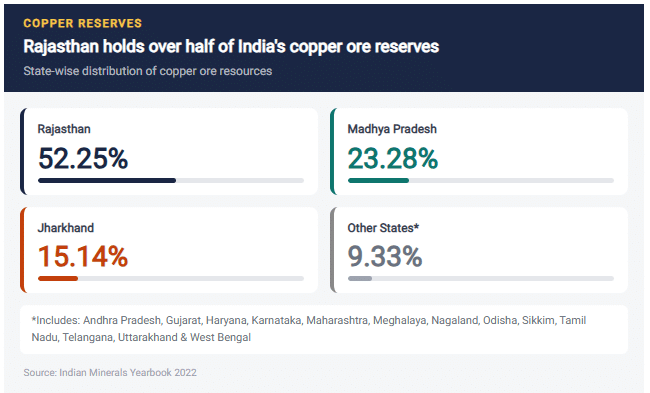
2. Copper reserves/resources in Andhra Pradesh, Gujarat, Haryana, Karnataka, Maharashtra, Meghalaya, Nagaland, Odisha, Sikkim, Tamil Nadu, Telangana, Uttarakhand and West Bengal accounted for the remaining 9.33% of the total All India resources.

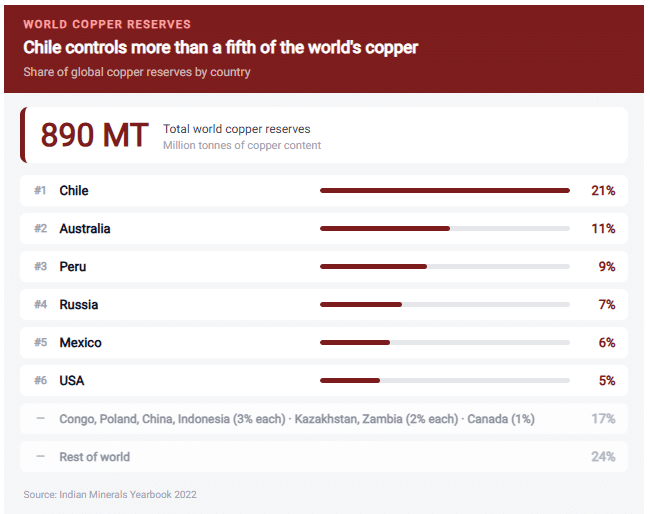
3. As per the Indian Minerals Yearbook 2022, the world reserves of copper metal are assessed at 890 million tonnes of copper content. Chile has the largest share, accounting for about 21% of world reserves, followed by Australia (11%), Peru (9%), Russia (7%), Mexico (6%), USA (5%), Congo (Kinshasa), Poland, China & Indonesia (3% each), Kazakhstan & Zambia (2% each) and Canada (1%). The remaining 24% was contributed by other countries.
Uses of Copper
1. According to the Indian Minerals Yearbook 2022, the electronic industry is by far the largest consumer of copper, where it is used in the form of cables and winding wires, as it is the best non-precious metal conductor of electricity, encountering much less resistance and being safe for electrical distribution systems from high-voltage transmission cables to microcircuits. Notably, Copper also has relatively high creep strength as compared to other commonly used materials.
2. Copper is used in the construction industry as plumbing, taps, valves and fittings components. In the transportation industry, copper is used in various components.
3. Copper is extensively used in industrial machinery and equipment. It is used in a number of consumer products, such as coinage, utensils, fixtures, etc. Large quantities of copper are consumed in making copper-based alloys, such as brass and bronze.
BEYOND THE HUNK: Substitutes of Copper
1. Copper is vulnerable for substitution on grounds of technical superiority, price, or weight. Aluminium is used as a substitute for copper in various products, such as electrical power cables, electrical equipment, automobile radiators and cooling/refrigeration tubing.
2. Optical fiber has substituted copper in some telecommunication applications, and plastics are used as a substitute for copper in water pipes, plumbing, fixtures and many structural applications.
Post Read Question
With reference to copper, consider the following statements:
1. Copper is a non-ferrous metal with high electrical conductivity.
2. It occurs in nature in directly usable metallic form.
3. It is widely used in power grids and microcircuits.
Which of the statements given above is/are correct?
(a) 2 and 3 only
(b) 1 and 3 only
(c) 3 only
(d) 1, 2 and 3
| Answer Key |
|---|
| (d) |
(Sources: Behind copper’s latest fall: West Asian conflict weighs on the metal’s demand outlook, ibm.gov.in, Indian Minerals Yearbook 2022 (Part- II : Metals & Alloys)
Don’t miss | UPSC Current Affairs Pointers of the past week (23–29 March 2026) | UPSC Lifebloods | Hunk of Knowledge