
At Jewar airport, Prime Minister Modi highlights the importance of India’s ethanol initiative as a protective measure against the energy crisis. How is ethanol produced? What government schemes support this push? In ‘Hunk of Knowledge,’ learn about Sustainable Aviation Fuel and Advanced Sustainable Fuel.
Take a look at the essential concepts, terms, quotes, or phenomena every day and brush up on your knowledge. Here’s your hunk of knowledge on ethanol production for today.
Hunk of Knowledge: Ethanol production
Subject: Economy and Policy
(Relevance: In UPSC Prelims, questions have been asked on the production of biofuels; do check them at the end of the article. As the crude oil crisis looms amidst Iran vs Israel-US War, it is important to comprehensively understand India’s Ethanol push- from production, processing to government support.)
Why in the news?
While speaking at the inauguration of Phase I of the Noida International Airport (NIA)in Jewar, Prime Minister Narendra Modi referred to India’s ethanol push helping the country through the global energy crisis.
“If production of ethanol had not increased, and its blending with petrol, then the country would have had to import an additional 4.5 crore barrels, which is almost 700 crore litres of crude oil, every year…,” he had said.
Key takeaways:
1. Ethanol, or ethyl alcohol, is a liquid that has several uses. At 95% purity, it is called rectified spirit and is used as the intoxicating ingredient in alcoholic beverages. At 99%-plus purity, ethanol is used for blending with petrol.
2. Ethanol is a common type of biofuel, a renewable fuel derived from biomass, from plants or agricultural, animal, domestic, and industrial bio waste. Biofuels are significantly cleaner than conventional fossil fuels, though lifecycle impacts vary based on feedstock and production methods.
When ethanol is produced from these sources, it is called bioethanol (a subset of Ethanol). Bioethanol can be easily generated from sugarcane, beet juice, corn, rice, or other grains. These fuels are known as first-generation biofuels.
Different generations of Biofuels
According to the National Policy on Biofuels, different generations of Biofuels are:
(i) First Generation (1G) produces bio-ethanol from molasses and bio-diesel from non-edible oilseeds.
(ii) Second-generation (2G) ethanol can be produced from municipal solid waste
(iii) Third Generation (3G) fuels like bio-CNG
Ethanol Production from sugarcane
1. Ethanol is produced from molasses, which is a by product of sugar manufacturing. For making sugar, mills crush sugarcane, which typically has a total fermentable sugar (TFS) content of 14%. The TFS component consists of sucrose along with the reducing sugars glucose and fructose. Most of this TFS component gets crystallised into sugar, and the remaining part is called molasses.
2. The molasses go through three stages — A, B, and C, the last one being where the molasses are most uncrystallised and non-recoverable. The ‘C’ molasses roughly constitute 4.5% of the cane, and has a remaining TFS of 40%.
After C-molasses are sent to the distillery, ethanol is extracted from them. Every 100 kg of TFS yields 60 litres of ethanol. Thus, from one tonne of cane, mills can produce 115 kg of sugar (at 11.5% recovery) and 45 kg of molasses (18 kg TFS), which gives 10.8 litres of ethanol.

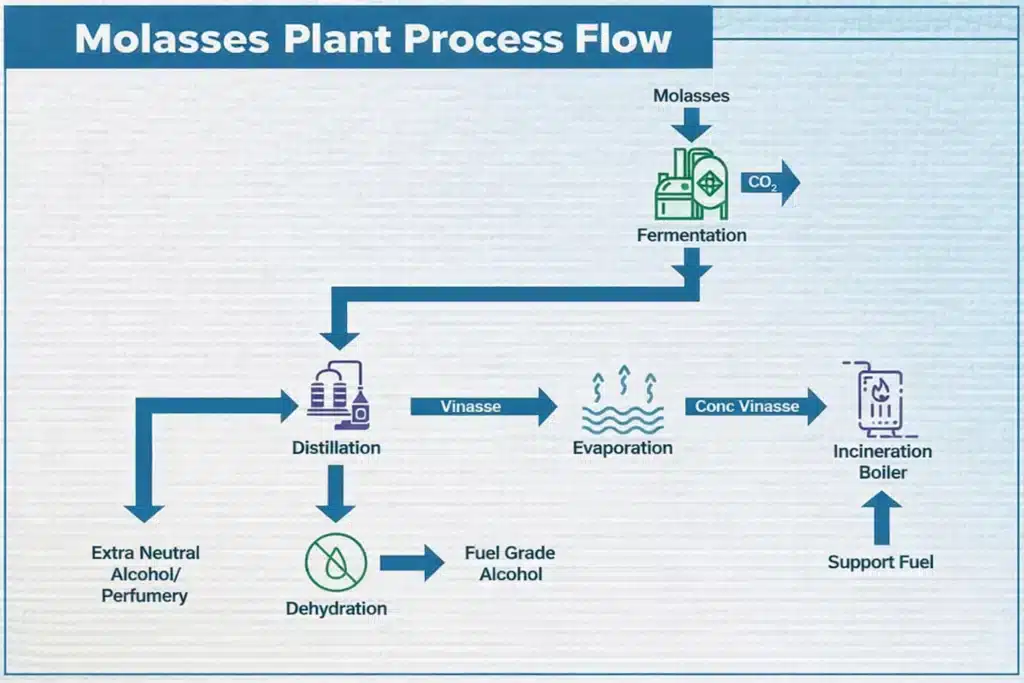
3. In between the two extreme cases, there are intermediate options as well, where the cane juice does not have to be crystallised right till the final ‘C’ molasses stage. The molasses can, instead, be diverted after the earlier ‘A’ and ‘B’ stages of sugar crystal formation. Mills, then, would produce some sugar, as opposed to fermenting the whole sugarcane juice into ethanol.
If ethanol is manufactured using ‘B’ heavy molasses (7.25% of cane and with TFS of 50%), around 21.75 litres will be produced along with 95 kg of sugar from every 1 tonne of cane.
4. Till 2017-18, mills produced ethanol only from so-called C-heavy molasses, the final dark brown liquid by product of cane processing containing sucrose that cannot be further economically recovered and crystallised into sugar.
5. From the 2018-19 supply year, mills began making ethanol from an earlier ‘B-heavy’ stage molasses (having higher sucrose content available for fermentation) and also directly from whole cane juice or syrup.
6. The result: Between 2013-14 and 2018-19, the total supply of ethanol to oil marketing companies (OMC) shot up from a mere 38 crore to nearly 189 crore litres. The all-India average ethanol blending in petrol, too, rose from 1.6% to over 4.9%.
Ethanol production from other cereal grains
7. From 2018-19, the government also fixed separate ex-distillery prices for ethanol derived from rice, maize, and damaged food grains.
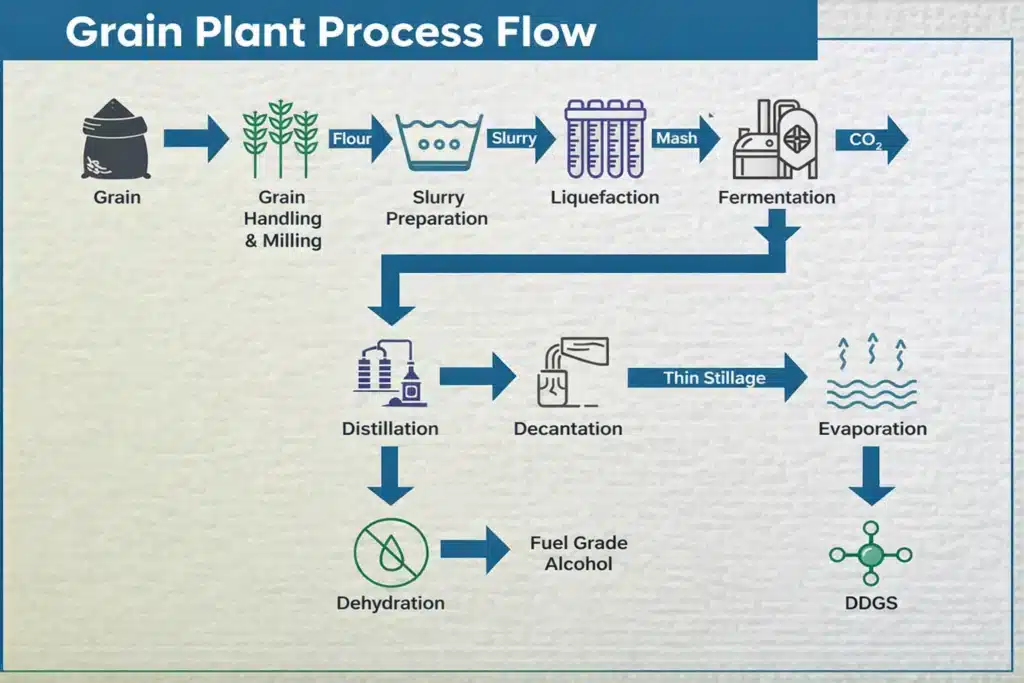
8. In molasses or cane juice, sugar is present in the form of sucrose. In cereal grains, starch is available, which is a complex carbohydrate. Starch from cereal grains is first extracted and broken down into simple sugars before further fermentation, distillation, and dehydration to ethanol with 99.99% alcohol concentration.
9. While the ethanol blending is seen as a step towards reducing India’s crude oil imports, which is significant amidst the Iran vs Israel-US war, leading to disruption of oil imports from the Strait of Hormuz.
Experts have highlighted concerns related to increased water use in sugarcane cultivation, the fiscal costs of subsidies, and concerns over diverting food crops for fuel. According to energy analysts and industry reports, ethanol is vital, but it should be seen as part of a broader energy transition strategy rather than a standalone solution.
Government Initiatives
National Policy on Biofuel, 2018
It provides an indicative target of 20% ethanol blending under the Ethanol Blended Petrol (EBP) Programme by 2030. The Minister of State in the Ministry of Petroleum & Natural Gas informed the Rajya Sabha in December 2025 that the Public Sector Oil Marketing Companies (OMCs) had achieved the target of 10% Ethanol blending in petrol in June 2022, ahead of the set deadline.
Pradhan Mantri JI-VAN (Jaiv Indhan- Vatavaran Anukool fasal awashesh Nivaran) Yojana
This scheme was launched by the government in 2019. This scheme provides financial assistance for setting up Advanced Biofuels projects in the country using lignocellulosic biomass and other renewable feedstock, multimodal transportation of ethanol and increasing ethanol storage capacity, along with other allied infrastructure for handling higher blends of ethanol.
Global Biofuel Alliance
It was launched in 2023 to facilitate international cooperation and intensify the use of sustainable biofuels, along with facilitating global biofuels trade and technical support for national biofuel programmes.
BEYOND THE HUNK: Other sustainable fuels that are in the news
1.Sustainable Aviation Fuel (SAF): Last year, Indian Oil Corporation (IOC) became the first company in India to receive the ISCC CORSIA certification for SAF production at its Panipat refinery in Haryana.
AF is a biofuel that is produced from sustainable feedstocks and has chemistry similar to conventional aviation turbine fuel (ATF) or jet fuel, which is derived from crude oil. It is a ‘drop-in’ fuel, meaning it can be blended with ATF without requiring any change in the existing machinery of aircraft.
2.Advanced Sustainable Fuel (ASF):New rule changes were brought under the Formula 1 race season 2026, which require the internal combustion engine of the F1 race car to use the ‘advanced sustainable fuel’. It is sourced from sustainable feedstocks that are not in competition with food crops.
These feedstocks include municipal waste and non-food biomass; the fuel can also be produced using technologies like carbon capture, harnessing carbon from the air and industrial emissions. The advanced sustainable fuel must be a drop-in fuel, meaning it should be designed to replace fossil fuels without requiring any engine adjustments.
Post Read Question
According to India’s National Policy on Biofuels, which of the following can be used as raw materials for the production of biofuels? (2020)
1. Cassava
2. Damaged wheat grains
3. Groundnut seeds
4. Horse gram
5. Rotten potatoes
6. Sugar beet
Select the correct answer using the code given below:
(a) 1, 2, 5 and 6 only
(b) 1, 3, 4 and 6 only
(c) 2, 3, 4 and 5 only
(d) 1, 2, 3, 4, 5 and 6
| Answer key |
| (a) |
Don’t miss | UPSC Current Affairs Pointers of the past week (23–29 March 2026) | UPSC Lifebloods | Hunk of Knowledge