Gold prices are falling despite global tensions, why is the classic safe haven losing its shine? understand the role of crude oil, the US dollar, and interest rates, along with gold’s properties, uses and distribution. Also, go ‘Beyond the Nugget’ to know about another precious industrial metal.
Take a look at the essential events, concepts, terms, quotes, or phenomena every day and brush up your knowledge. Here’s your UPSC Current Affairs hunk of knowledge for today on Gold.
Hunk of Knowledge: Gold
Subject: Economy and Geography
(Relevance: Given the fluctuation in the price of gold and changing safe-haven dynamics in the global economy, it becomes important to know about this precious yellow metal not only from an economic standpoint but also through demand, consumption and geographical perspectives.)
Why in the news?
Gold prices have crashed sharply amid the ongoing war in West Asia. Previously, prices of the yellow metal had surged in 2025 and early 2026 to multiple record highs when the US’ tariff threats had plundered markets around the world and had weighed on the US dollar. Gold prices on both the domestic and global markets are down around 27% from their January peak, despite the war in West Asia battering global markets.
In this context, let’s understand why gold prices are down after 2025’s historic surge and why there is no safe-haven demand for bullion currently, as seen earlier when geopolitical uncertainty was elevated, and know about the precious yellow metal in detail.
Key Takeaways:
1. The key aspect holding back safe-haven demand for gold this time is the sky-high prices of crude oil. High crude prices lead to fears of inflation levels rising around the world, which delays rate cuts by central banks around the world. Some central banks may even consider raising interest rates to combat inflation if the situation worsens as the West Asia conflict prolongs itself.
2. The US dollar has also emerged as a safe-haven asset this time around. The dollar index, which measures the strength of the dollar against many other global currencies, has strengthened by over 2% to around 100 since the West Asian war began, compared to the 96 levels it had dipped to when the US tariff threats were at a peak. This has provided an opportunity for investors to book some profits in gold after its rally to the peak, leading to a fall in gold prices, and instead invest in the US dollar.
3. The stronger dollar makes assets priced in the US currency – such as gold and silver – more expensive, thereby hurting their demand and prices.
Gold and its Properties
1. Gold in its purest form is a bright, slightly reddish yellow, dense, soft malleable and ductile metal. It is one of the least reactive chemical elements and is solid under standard conditions.
2. Gold often occurs in free elemental (native) form, as nuggets or grains, in rocks, in vein and in alluvial deposits. Gold is resistant to corrosion and to most acid and has unique properties distinct from other metals.
3. Gold dissolves in an alkaline solution of cyanide, which is used in mining and electroplating. It also dissolves in mercury, forming amalgam alloys, but this is not a chemical reaction.
Distribution
1. Gold is a relatively scarce metal in the world and a scarce commodity in India. The domestic demand is mainly met through imports.
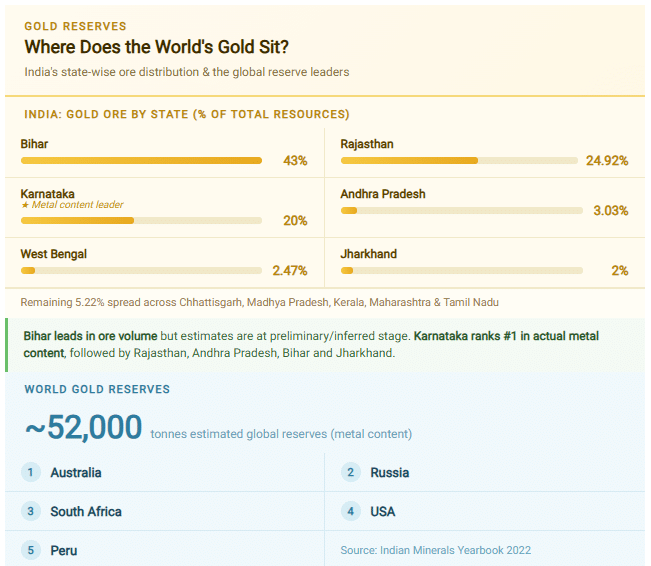
2. According to the Indian Minerals Yearbook 2022 (Part II: Metals & Alloys), by states, the largest resources in terms of gold ore (primary) are located in Bihar (43%), followed by Rajasthan (24.92%), Karnataka (20%), West Bengal (2.47%), Andhra Pradesh (3.03%) and Jharkhand (2%). The remaining 5.22% of resources of ore are located in Chhattisgarh, Madhya Pradesh, Kerala, Maharashtra and Tamil Nadu.
3. Although Bihar is the leading State in India as far as resources of gold ore are concerned, the resource estimates are at preliminary stage and falls under Inferred and Reconnaissance categories. In terms of metal content, Karnataka remained on top, followed by Rajasthan, Andhra Pradesh, Bihar, Jharkhand, etc.
4. According to the Indian Minerals Yearbook 2022 (Part II: Metals & Alloys), the estimated world reserves of gold were about 52,000 tonnes of metal content. The gold reserves are mainly located in Australia, Russia, South Africa, USA, Indonesia, Brazil and Peru.

Demand and Consumption of Gold
1. Jewellery accounts for major consumption of gold. The Industrial demand especially in the Electrical Sector for gold is mainly due to excellent thermal and electrical properties. Besides, a significant amount is consumed in dentistry and medicine.
2. Continuing research has discovered new applications for gold as a catalyst and in nano-technology.
3. Gold is considered a valuable asset, for investments and bank reserves.
BEYOND THE HUNK: Silver – a precious and industrial metal
1. Unlike gold, which is primarily purchased by households and central banks as a store of value and investment, silver actually has inherent physical properties that make it a key component in the manufacture of items, such as batteries and solar panels. These sectors are not only in vogue now but will be crucial to the future of humanity.
2. Silver is also used to make jewellery and coins. That is why buyers and their reasons to purchase silver are more varied than those of gold.
3. Silver is a soft and lustrous metal that is classified as a noble metal. Its white colour, malleability and resistance to atmospheric oxidation have enhanced its value as a highly desired precious metal which is used in many industrial applications.
4. Apart from its monetary and decorative uses, silver is known to have the highest electrical conductivity amongst all metals that enhances its potential in modern age applications, viz, for printed electric circuits, coating for electronic conductors and in alloys of gold and copper for electrical contacts.

5. Its chloride and iodide are light-sensitive and hence used in photographic material. Silver is typically used (in paste form) on solar cells. Silver is the whitest element and has the highest electrical and thermal conductivity among all the metals.
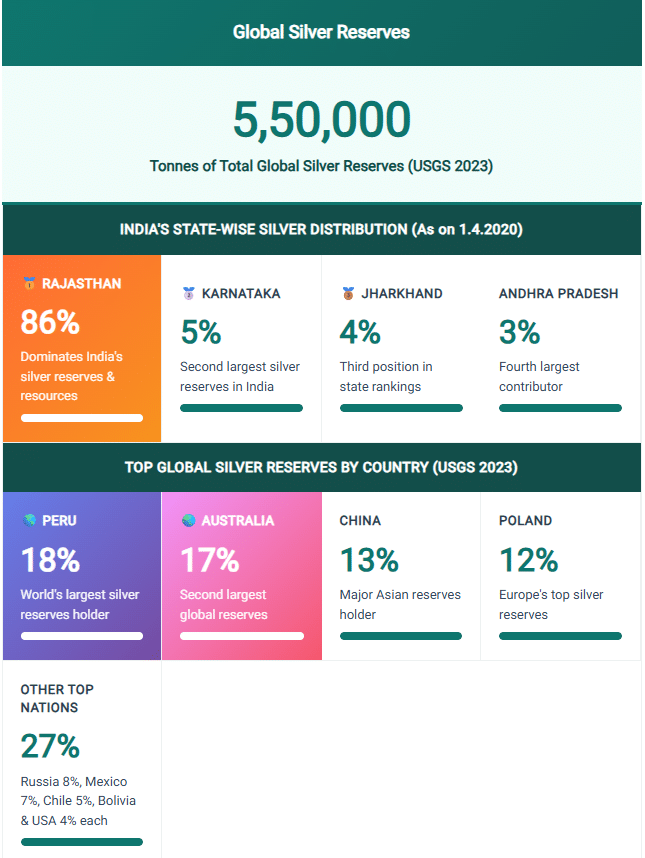
6. In India, there are no native silver deposits except the small and unique Bharak deposit in Rajasthan. It occurs generally with lead, zinc, copper (especially their sulphide ore) and gold ores and is extracted as a by-product from electrolysis or chemical methods. It was usually extracted by melting silver-bearing lead ore (ore containing argentiferous galena).
7. According to Indian Minerals Yearbook 2022, Silver is recovered as a co-product as well as a by-product in the country. Silver was recovered in the past as a co-product in gold refining at KGF Complex and Hutti Gold Mines in Karnataka and as a by-product in smelting and refining of lead, zinc and copper concentrates at Chanderiya and Debari smelters in Rajasthan, Tundoo and Moubandar (Ghatsila) smelters in Jharkhand and at Visakhapatnam smelter in Andhra Pradesh.
Post Read Question
Consider the following statements with reference to gold:
1. Gold is highly reactive and easily corroded.
2. It occurs in native form in rocks and alluvial deposits.
3. It dissolves in cyanide solution.
Which of the statements given above is/are correct?
(a) 1 only
(b) 2 and 3 only
(c) 1 and 2 only
(d) 1, 2 and 3
| Answer Key |
|---|
| (b) |
Don’t miss | UPSC Current Affairs Pointers of the past week (23–29 March 2026) | UPSC Lifebloods | Hunk of Knowledge